-
Guxiang Town, Chaozhou City,Guangdong Province, China

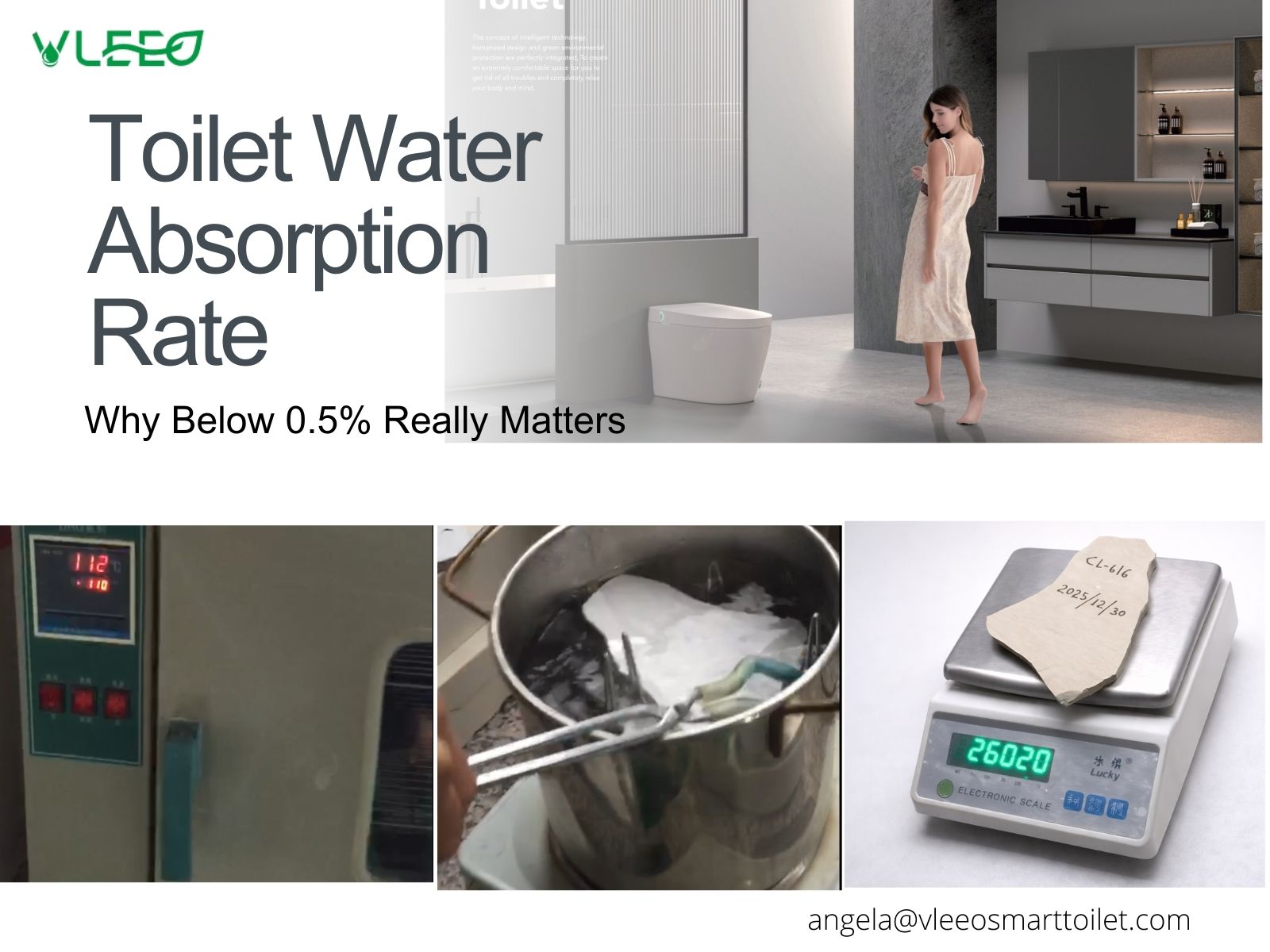
Toilet Water Absorption Rate: Why Below 0.5% Really Matters
When people choose a toilet, they usually focus on flushing power, appearance, or smart features.
Very few people ask about the toilet water absorption rate.
That’s understandable, because it sounds technical and it is invisible.
But in real bathrooms, this single number quietly decides how clean a toilet stays, how long it lasts, and whether it will age well or cause problems years later.
Once you understand it, toilet quality becomes much easier to judge.
What Is Toilet Water Absorption Rate?
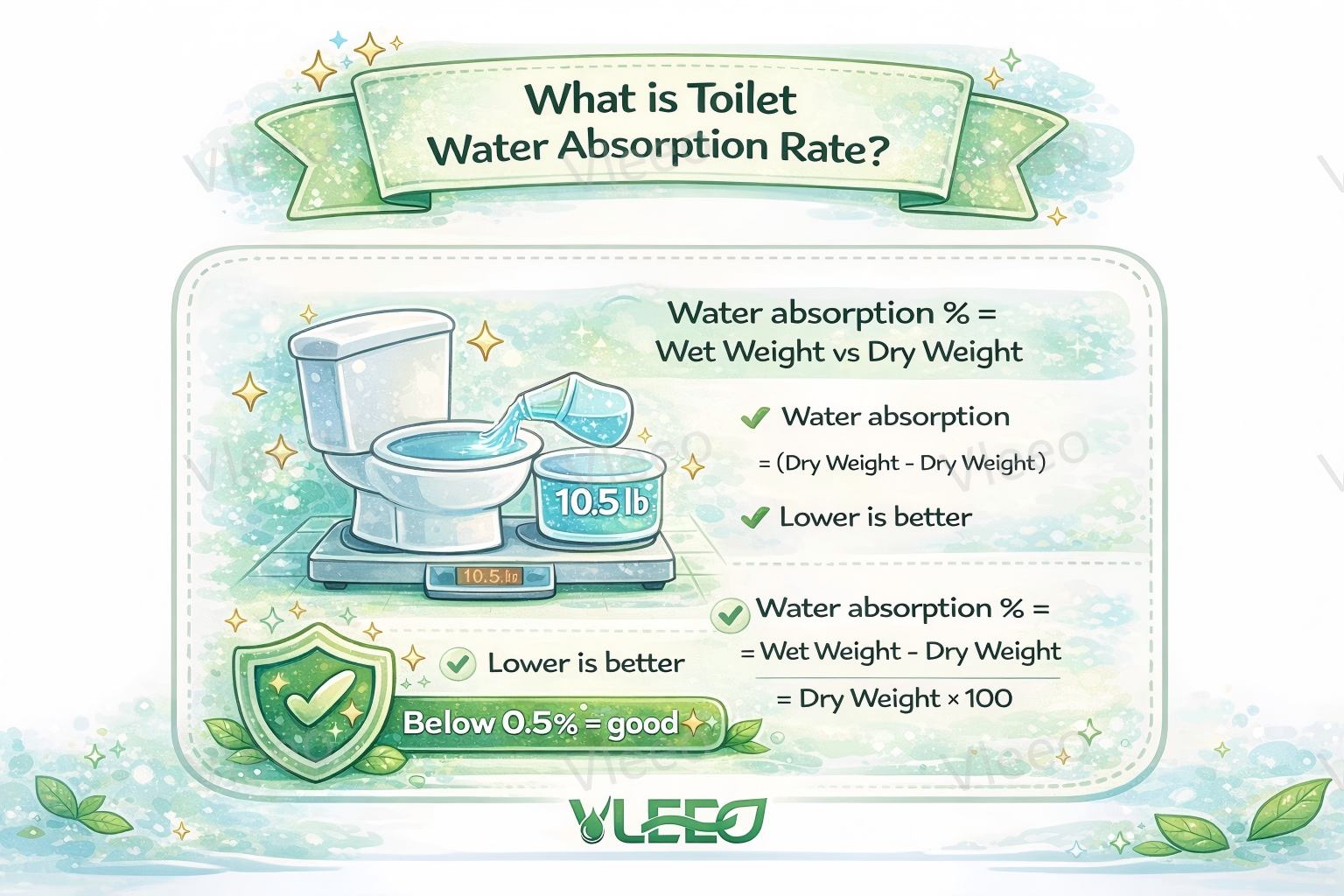
The toilet water absorption rate measures how much water a toilet’s ceramic material absorbs compared to its dry weight.
It is expressed as a percentage.
- 0.5% means the material absorbs half of one percent of its own weight in water
- Lower is better
Bathrooms are constantly exposed to moisture.
Steam, splashes, cleaning water, and daily humidity all add up.
If the ceramic body absorbs water, moisture slowly enters the material instead of staying on the surface. Over time, this leads to hidden but serious issues.
How Water Absorption Is Tested (Industry Method)
Water absorption is measured using a standardized weight-difference method.
The basic principle is widely used across industries. According to Intertek, ASTM D570 evaluates water absorption by comparing dry weight and wet weight after controlled water exposure, helping determine how materials behave in humid environments:
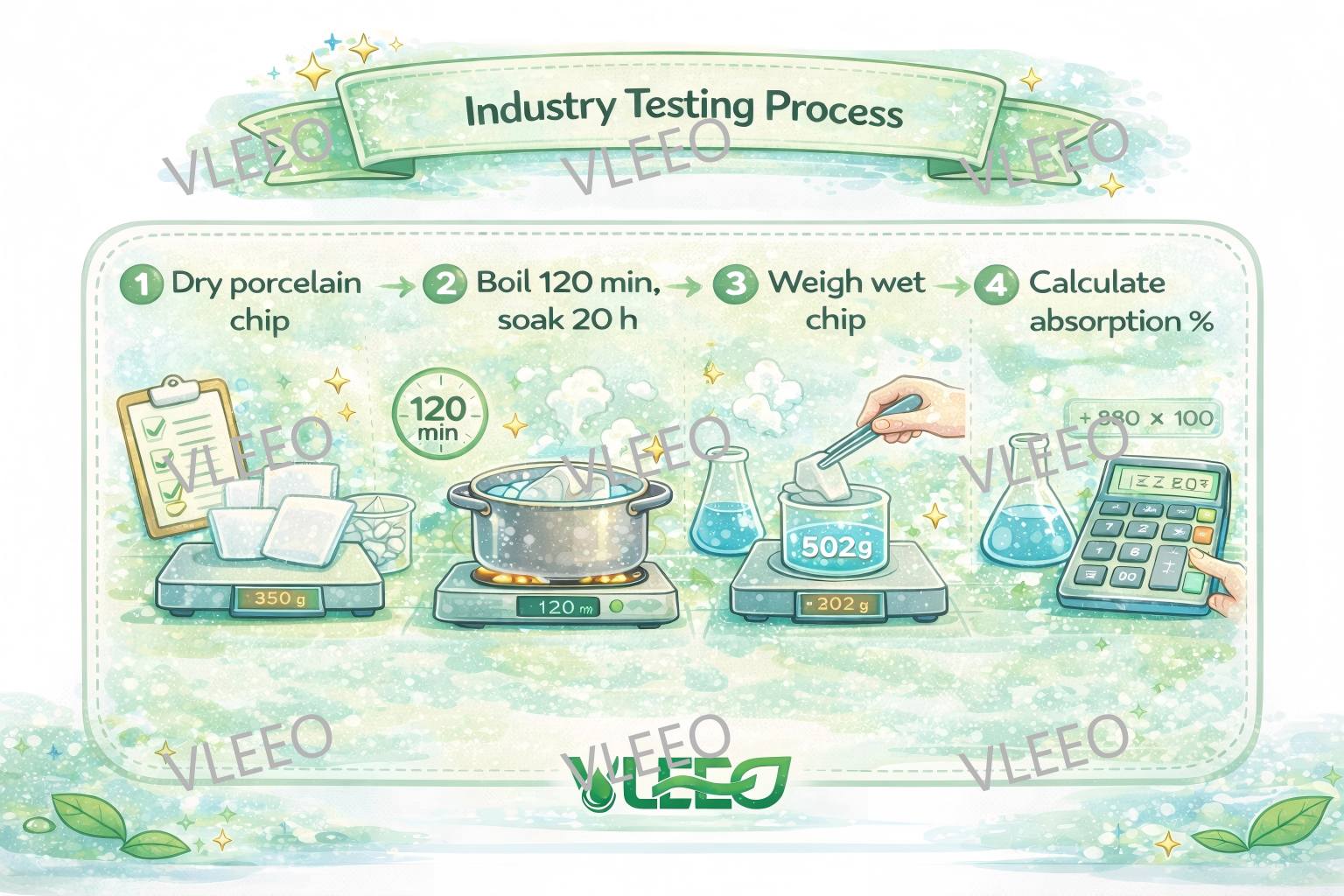
In simple terms, the process includes:
- Drying the ceramic sample completely
- Recording the dry weight
- Exposing the sample to water for a fixed time
- Weighing again and calculating the percentage increase
The formula looks like this:
Water Absorption (%) = (Wet Weight − Dry Weight) ÷ Dry Weight × 100
This method focuses on material performance, not surface appearance.
How the Test Is Actually Done at Vleeo
Here is an important detail most buyers never see.
In real production, many manufacturers apply stricter internal tests than what is described in simplified explanations.
At Vleeo, water absorption rate is treated as a must-test, not an optional check.
In the laboratory, the process is more demanding:
- Porcelain samples are dried at 110°C until fully moisture-free
- The dry weight is recorded as M0
- Samples are placed into boiling water and cooked for 120 minutes
- After heating stops, samples remain still in water for 20 hours
- The final weight is recorded as M1, and absorption is calculated
E = [(M1 − M0) / M0] × 100%
This stricter approach puts more stress on the ceramic and helps ensure stable performance in real bathrooms.
Why “Below 0.5%” Is a Key Benchmark
A water absorption rate below 0.5% is widely recognized as a quality threshold for porcelain and vitreous china toilets.
Here’s why that number matters in daily use.
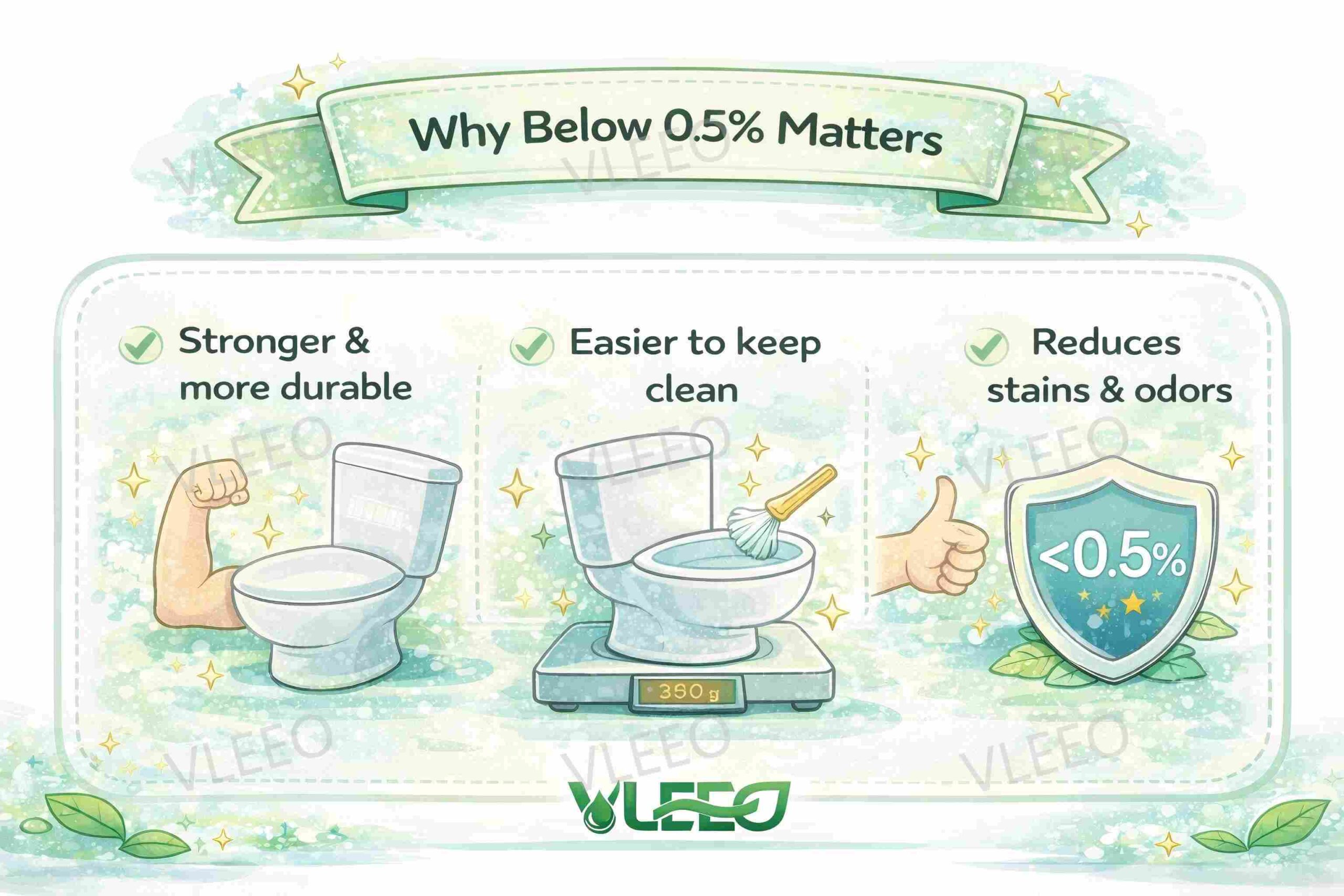
1. Better Strength and Long-Term Durability
Low absorption means the ceramic body is dense.
Dense materials:
- Resist cracking
- Handle temperature changes better
- Keep their structure over time
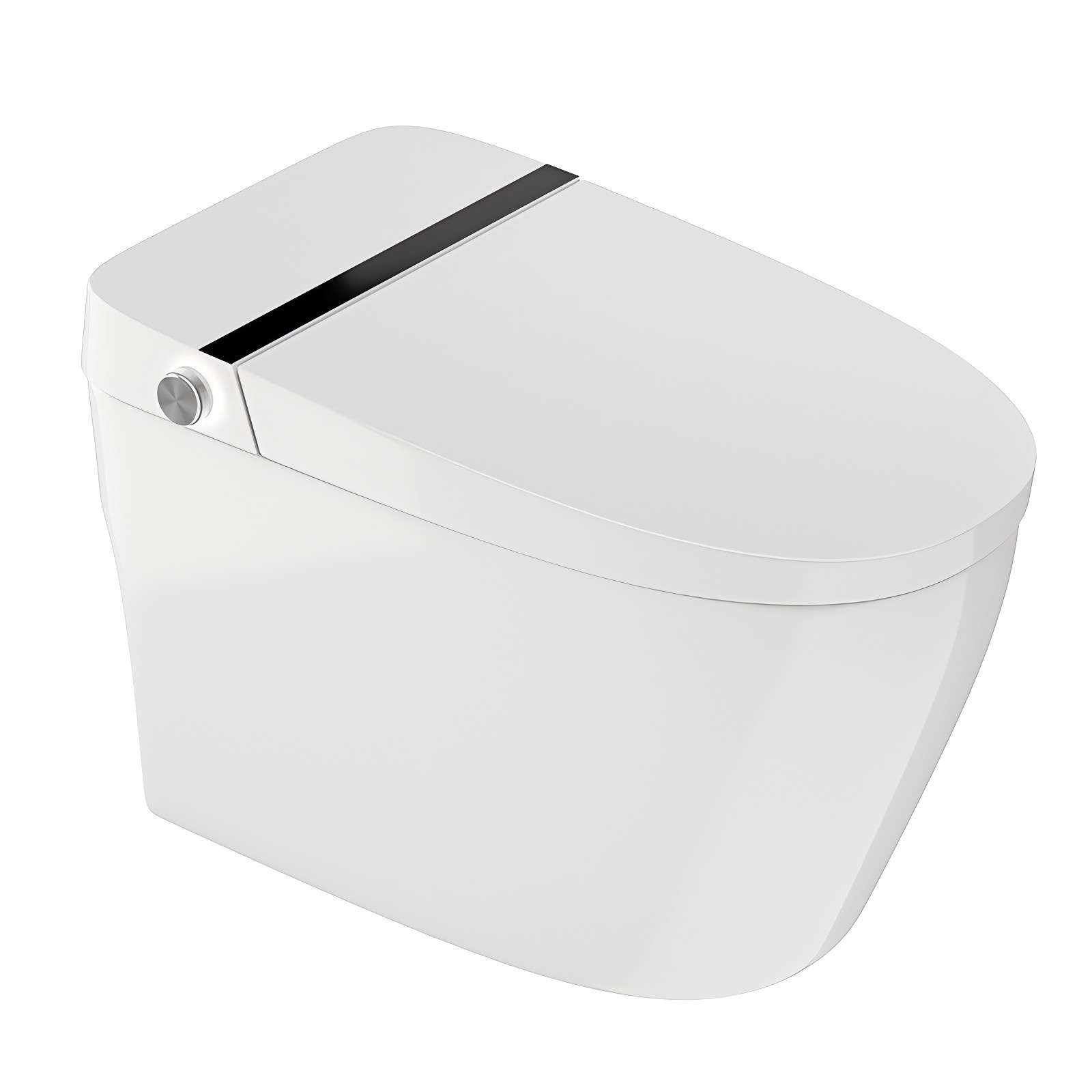
Even entry-level smart toilets rely on this principle. For example, the CL-616 entry level smart toilet focuses on solid material quality to ensure long-term reliability, not just basic functionality:
Durability starts with the ceramic body.
2. Improved Hygiene and Easier Cleaning
Water absorption is closely linked to porosity.
More pores mean:
- More places for bacteria
- Odors that are harder to remove
- Stains that slowly become permanent
Low-absorption toilets have smoother, denser surfaces. They stay cleaner with less effort, which is especially important for premium models like the CL-711 smart toilet, where hygiene and surface quality are part of the overall experience.
3. Better Appearance Over Time
When moisture cannot enter the ceramic body, stains cannot settle inside it.
Low-absorption toilets:
- Stay whiter
- Resist yellowing
- Maintain surface gloss longer
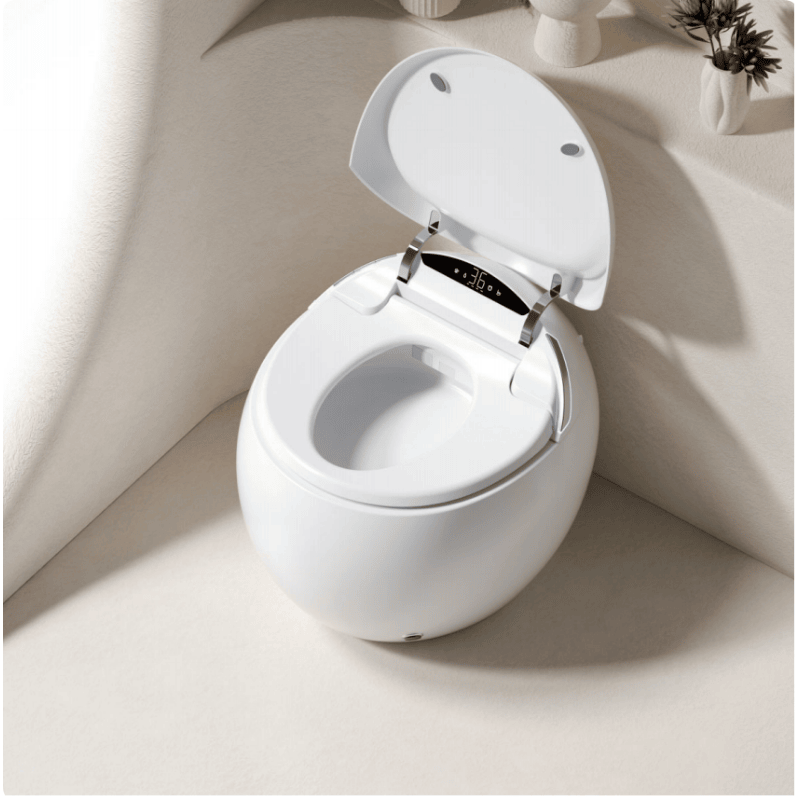
This is why special-design toilets, such as the WL-1015 egg shape smart toilet, can combine unique appearance with long-term durability.
Design does not have to sacrifice performance.
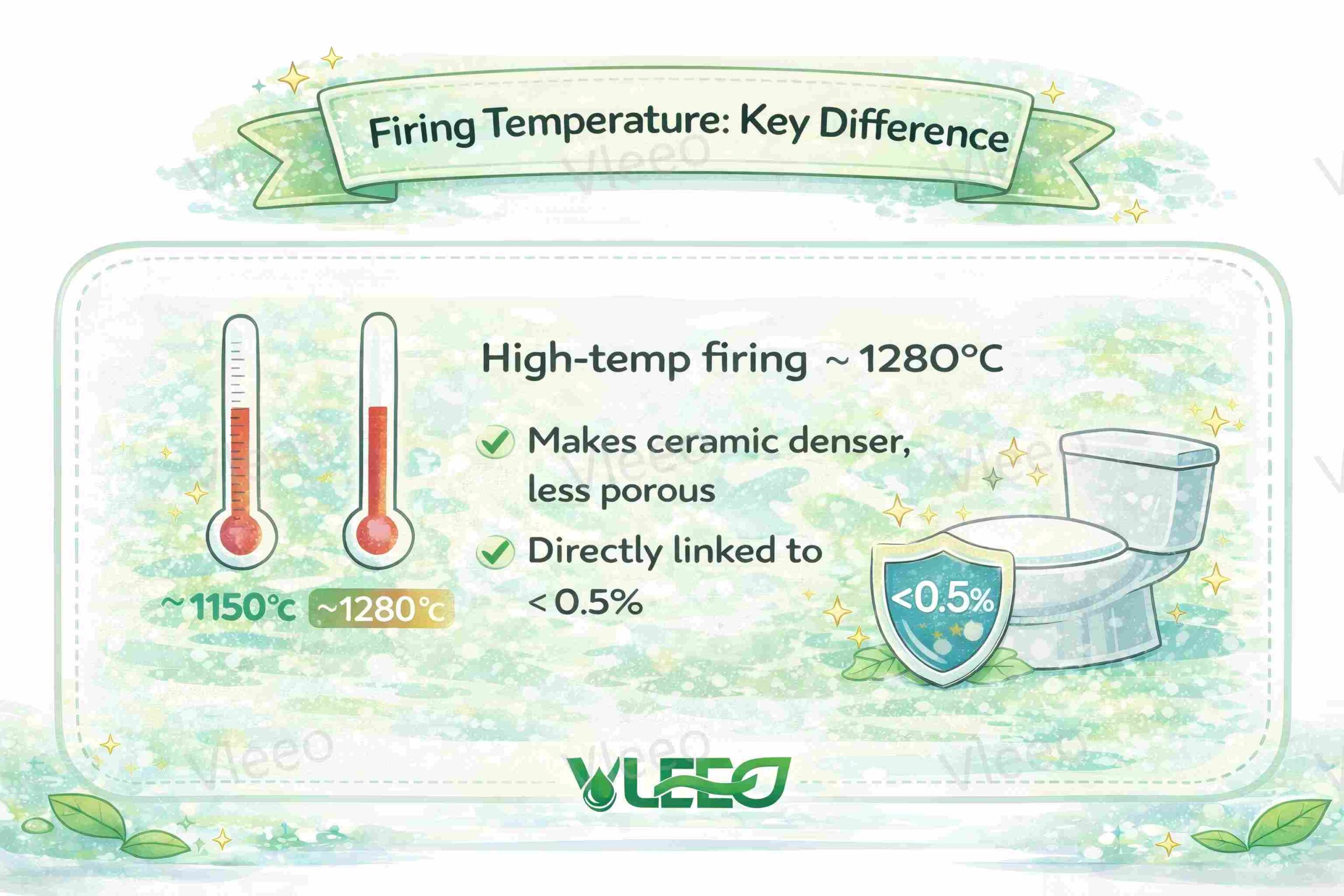
Porcelain/Ceramic: Why Fired Temperatures Affect Water Absorption Rate
Although people often use the terms interchangeably, porcelain and ceramic behave differently.
Porcelain toilets
- Fired at higher temperatures (at Vleeo/Cleanman, toilets are fired at approximately 1280°C).
- Denser internal structure
- Typically absorb less than 0.5%
Standard ceramic
- More porous
- Higher absorption
- More prone to moisture-related aging
This difference often appears after years of use, not on day one.
Why Water Absorption Matters for Smart Toilets
Smart toilets integrate:
- Sensors
- Heating elements
- Seals
- Internal water channels
Moisture control becomes critical.
Industry research shows that modern smart toilets are designed to keep water absorption well below 0.5% to protect internal systems and maintain long-term reliability.
Low absorption helps ensure:
- Stable seals
- Reliable flushing performance
- Longer service life for smart components
Environmental and Cost Impact
Low absorption also supports sustainability.
Durable toilets:
- Last longer
- Reduce replacement frequency
- Lower manufacturing waste
According to Express Sewer, high-efficiency toilets help reduce overall water usage over time, especially when long-lasting materials are used:
Water efficiency is not just about flush volume.
The U.S. Environmental Protection Agency WaterSense program (epa.gov) also emphasizes balancing performance, durability, and water savings in residential toilets:
Material quality plays a quiet but important role in sustainability.
Frequently Asked Questions About Toilet Water Absorption Rate
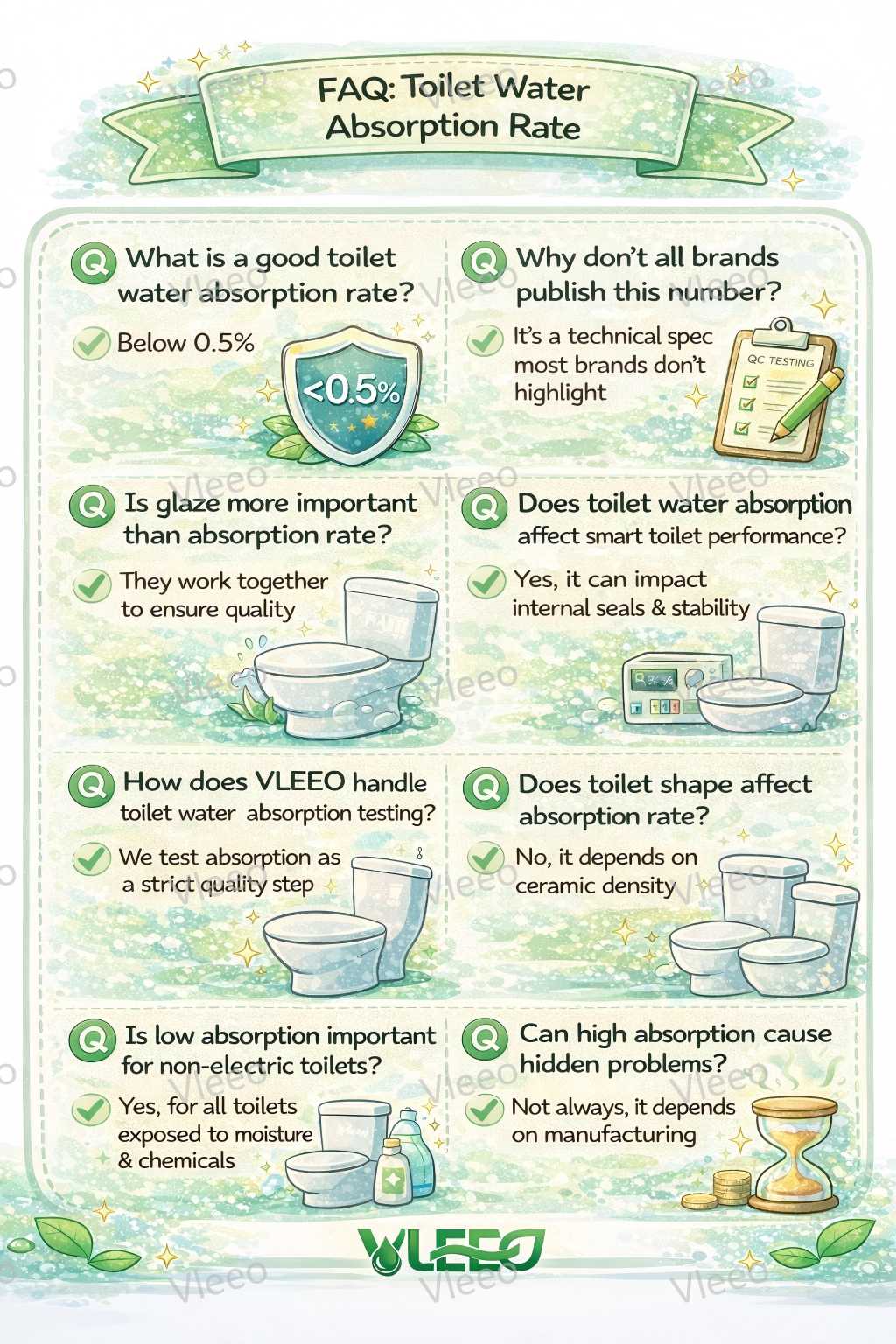
A good toilet water absorption rate is below 0.5%. This indicates a dense ceramic body that resists moisture, stains, and long-term degradation.
Many manufacturers test absorption internally but do not publish it because it is a technical parameter most consumers do not ask about.
However, serious manufacturers still test it because it affects durability and warranty performance.
They work together.
Absorption rate reflects internal material quality. Glaze protects the surface.
A good glaze cannot fully compensate for a porous ceramic body.
Yes.
Moisture absorbed into the ceramic can slowly affect seals and internal stability. That is why smart toilets demand stricter material control.
At Vleeo, water absorption rate testing is a required quality step.
Ceramic bodies are tested under controlled high-temperature and boiling-water conditions to ensure absorption remains within strict limits. This supports stable performance across different climates and usage environments.
No.
Shape affects appearance and ergonomics, not material behavior.
Absorption depends on raw materials, firing process, and ceramic density.
Yes.
All toilets are exposed to moisture and cleaning chemicals. Low absorption improves hygiene and lifespan regardless of electronic features.
Yes.
Higher absorption can lead to:
- Odors that do not wash away
- Micro-staining inside the ceramic
- Faster glaze aging
These issues usually appear slowly over time.
Not directly.
Price reflects many factors.
Water absorption reflects manufacturing discipline and material control.
The toilet water absorption rate does not change how a toilet looks when it is new.
It changes how it performs years later.
Final Thoughts
Toilet water absorption rate is easy to ignore.
But it quietly decides how a toilet performs over time.
A rate below 0.5% means better hygiene, stronger ceramic, and longer lifespan.
It’s not about fancy features.
It’s about material quality.
And that starts with the ceramic/porcelain body you never see.