-
Guxiang Town, Chaozhou City,Guangdong Province, China

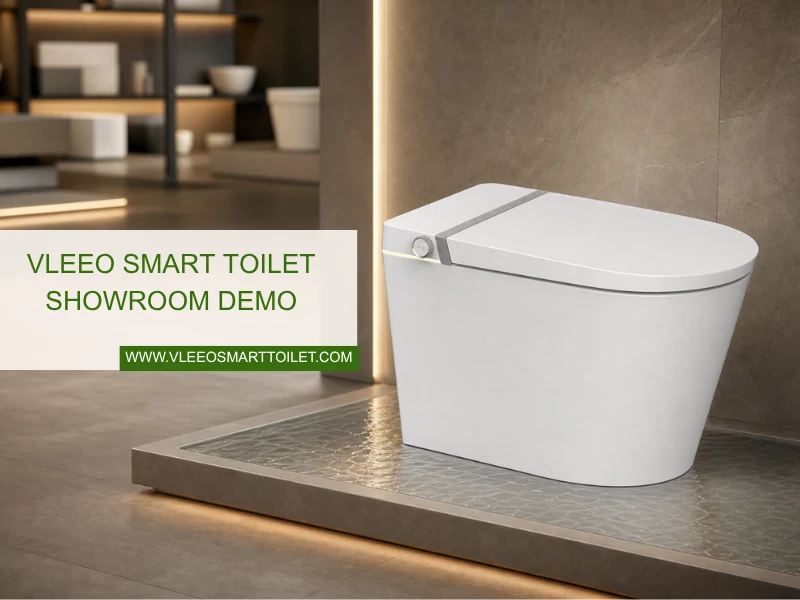
Smart Toilet Showroom Demo: A Practical Checklist for Distributors
Smart toilet showroom demo planning starts before anyone presses a remote. The room, water connection, display height, talking points, and order of the demonstration all shape what a visitor understands.
As a smart toilet manufacturer, VLEEO often works with buyers who know bathroom retail well but are showing smart toilets for the first time. One showroom project taught us a simple lesson: a smart toilet cannot explain itself from a silent platform.
Why the Finished Showroom Still Felt Flat
The products were ready. The showroom was clean and bright. Yet the buyer’s sales team still felt that every model looked like another white ceramic toilet until someone opened a specification sheet.
The buyer had created a polished bathroom display with tile samples, warm lighting, and enough space around the products. From the doorway, it looked professional.
During a trial walk-through, however, the conversation became technical too quickly. The salesperson pointed to icons for heated seating, washing, drying, automatic flushing, and sensors. Visitors were expected to imagine how those functions felt.
Most could not.
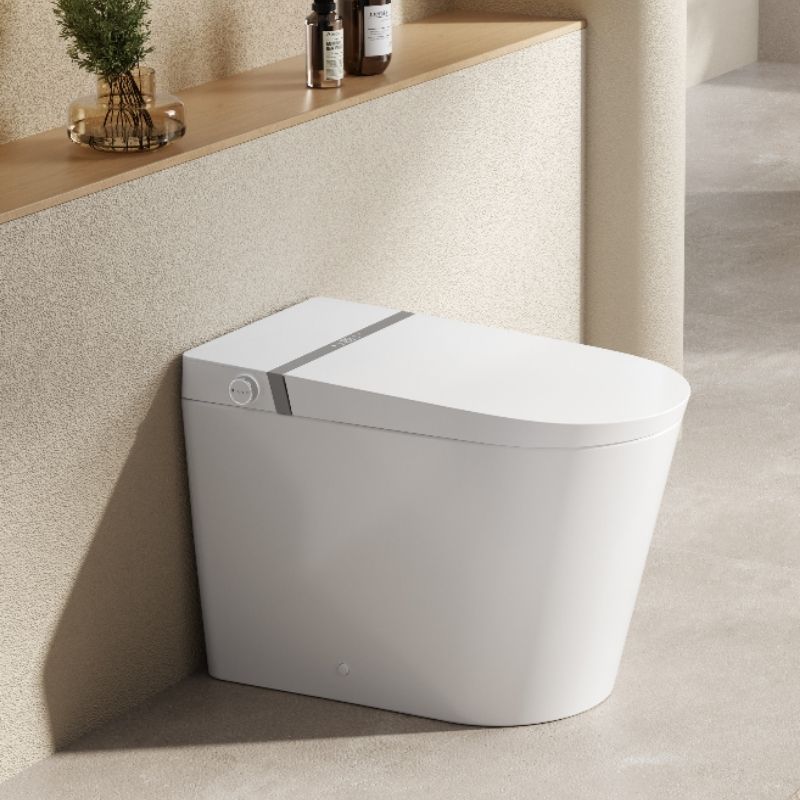
A smart toilet sits at an unusual point between sanitary ware and an electrical appliance. Shape and glaze matter, but much of the value only becomes clear when the product is powered, supplied with water, and demonstrated in a calm sequence.
The missing piece was not another model. It was a smart toilet showroom demo that gave the room a clear story.
We asked the buyer to stop thinking about the display as a row of models. Instead, we followed the visitor’s eyes from the moment they entered the room.
What would make them pause? What could they touch safely? Which function should they hear? Which difference would help them understand the next price level?
Those questions changed the project and gave the smart toilet showroom demo a clear purpose.
The Turning Point Was a Working Water Display
The buyer wanted to demonstrate washing and flushing, but the showroom had not been planned like a permanent bathroom. A normal installation would have limited flexibility, while a dry smart toilet showroom demo would hide the functions customers most wanted to see.
VLEEO helped the buyer source a suitable water-testing display stand as part of the supporting procurement service. The stand was not treated as decoration. It had to fit the selected toilet, support a practical water demonstration, and suit the showroom’s available space and utility conditions.
This type of support matters because overseas buyers are often coordinating several suppliers at once. The smart toilet may come from one factory, while the display stand, water circulation equipment, signage, and showroom construction come from others. A small mismatch can delay the opening or leave the main product sitting dry.
VLEEO did not replace the buyer’s local installer or showroom contractor. We helped connect the product requirements with the supporting display equipment so the local team had a clearer starting point.
Once the working display was in place, the room felt different. Water could move. The remote had a purpose. The salesperson no longer needed to describe every function in the abstract.
The product had a moment.
Build the Smart Toilet Showroom Demo Around Six Visitor Moments
A useful smart toilet showroom demo does not need to show every setting. It needs to answer the questions forming in the visitor’s mind.
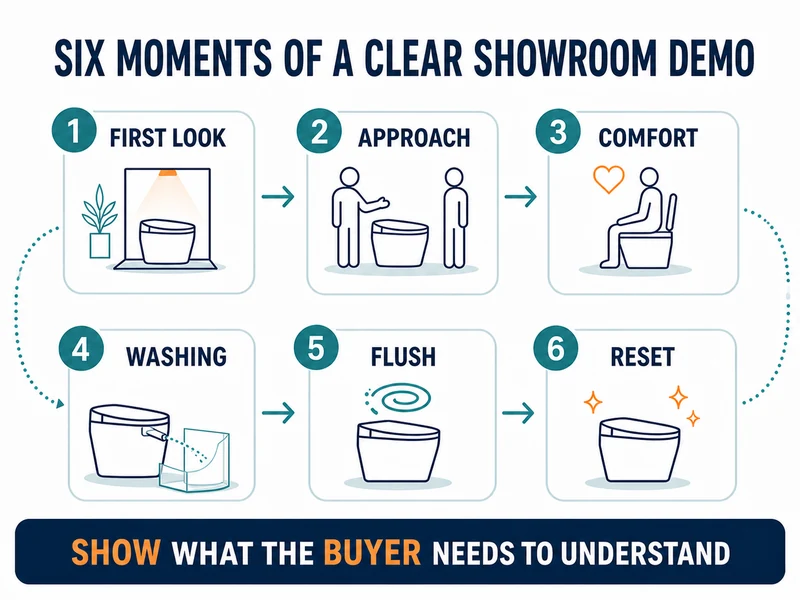
For this showroom, we organized the experience around six moments:
1. First look: Give the visitor room to see the ceramic shape, seat profile, control position, and how the model fits a real bathroom setting.
2. Approach: Demonstrate lid, seat, foot-sensor, or presence-sensor behavior only when those functions belong to the displayed configuration.
3. Comfort: Let the salesperson explain seat temperature and control logic in plain language. A visitor should know how daily use feels, not hear a list of heating levels.
4. Washing: Use the water-testing display to show nozzle movement, water direction, and available adjustments safely. Keep the explanation focused on hygiene, comfort, and control.
5. Flush: Allow the visitor to hear the flush and understand the relevant water-supply conditions. Do not claim that one performance result applies to every installation.
6. Reset: Show how the nozzle, bowl, seat, and control area are returned to a clean display condition before the next visitor.
The sequence is short enough for a normal showroom conversation. It also gives the salesperson natural places to stop and ask what the visitor cares about during the smart toilet showroom demo.
Some customers respond to comfort. Others focus on hygiene, easy operation, noise, or installation. A good smart toilet showroom demo makes those priorities visible without turning the visit into a lecture.
Keep the Smart Toilet Showroom Demo Honest
A smart toilet showroom demo creates trust when the demonstrated product matches the product that can actually be ordered.
Before opening, the buyer should confirm the model code, voltage, plug, remote-control version, flush configuration, seat functions, and any optional features. If the display sample has a function that is not included in the quoted configuration, the salesperson needs to say so clearly.
The same rule applies to certification and water-efficiency statements. Buyers can verify US WaterSense-labeled toilet models through the EPA WaterSense product search and plumbing listings through directories such as IAPMO’s product listing database. A showroom badge should reflect the exact model and listing, not a general claim about an entire product family.
This protects more than compliance. It prevents a visitor from ordering one product after experiencing another.
For VLEEO projects, we recommend keeping a small record behind each display: model name, sample version, electrical configuration, key options, document version, and the date the display was checked. The record stays with the sales team rather than becoming visual clutter in front of the customer.
Give the Salesperson Fewer Words and Better Prompts
When the water display began working, the buyer’s sales team first tried to explain everything. The demonstration became longer, not clearer.
We shortened it.
Instead of starting with a feature count, the salesperson could ask, “Which part matters most for your customers: easy operation, washing comfort, hygiene, or a more premium bathroom experience?”
That question gave the visitor a place in the conversation. The demo could then follow the answer.
For a distributor, this is commercially useful. A smart toilet showroom demo is not only a way to prove that functions work. It is where the sales team learns how local buyers describe value in their own words.
Those conversations can help the distributor decide which model should stay on the main platform, which feature needs clearer signage, and which questions should be answered in the local manual or sales training.
A Practical Smart Toilet Showroom Demo Readiness Check
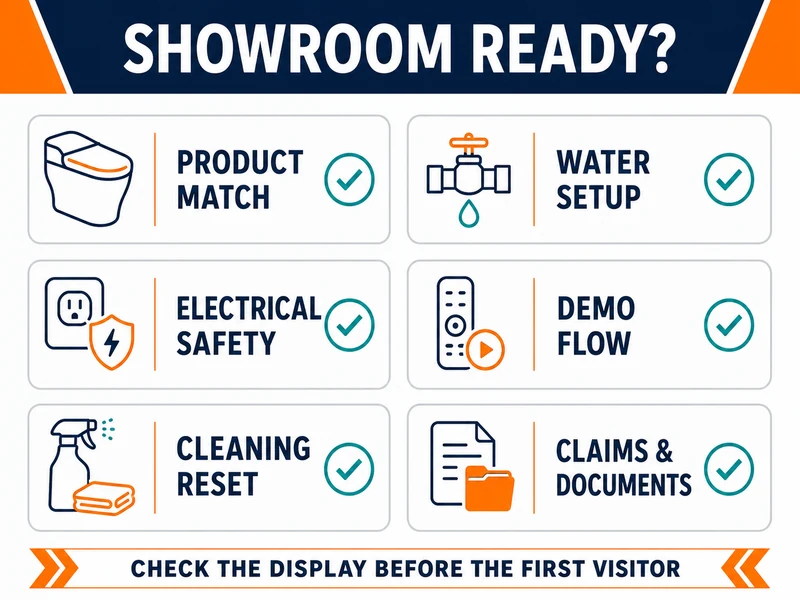
Before inviting customers, walk through the display as if you have never seen a smart toilet.
| Check | What the buyer should confirm | Why it matters |
|---|---|---|
| Product identity | Model, sample version, voltage, plug, control, and options match the sales record | Prevents configuration confusion |
| Water demonstration | Display stand, inlet, drainage or circulation method, pressure conditions, and splash control are ready | Keeps the live demo reliable and clean |
| Electrical safety | Local electrician has approved the outlet, grounding, protection, and cable route | Protects visitors and staff |
| Demo sequence | Sales staff can complete the six moments without reading a specification sheet | Makes the experience easy to follow |
| Cleaning reset | Towels, cleaning method, drainage check, and sample reset responsibility are assigned | Keeps the next demo presentable |
| Claims and documents | Product labels, listings, manuals, and sales statements match the displayed configuration | Builds buyer trust |
The electrical and plumbing setup must follow local rules and should be reviewed by qualified local professionals. The product manual and technical documents remain the reference for the selected model.
What Changed for the Buyer
The strongest change was not a dramatic new fixture. It was the way the team used the room and treated the smart toilet showroom demo as one connected experience.
The water-testing display stand allowed the smart toilet to perform instead of simply occupy space. The six-moment flow gave the salesperson a beginning and an end. Clear configuration records kept the conversation connected to the product the buyer could order.
The showroom also became easier to improve. If visitors paused at the flush, asked repeatedly about nozzle cleaning, or compared two control methods, the team could record those questions and adjust the next demonstration.
That is the atmosphere a smart toilet showroom needs: enough calm for the visitor to watch, enough movement for the product to feel real, and enough honesty for the buyer to trust what comes next.
Frequently Asked Questions
Does every smart toilet showroom demo need a live-water display?
Not every model needs to be connected. One carefully selected working unit can demonstrate the category, while nearby dry displays show different shapes, sizes, colors, or price levels. The connected sample should match the functions being presented.
Can VLEEO help buyers source showroom support equipment?
VLEEO can discuss supporting procurement needs for a project, including items such as a suitable water-testing display stand. Availability, design, compatibility, shipment method, and local installation requirements should be confirmed for each showroom.
What should never be demonstrated?
Do not demonstrate a function that is not included in the displayed configuration, bypass safety controls, or create water and electrical conditions that have not been approved locally. Avoid broad certification or performance claims that cannot be tied to the exact model.
How long should a normal demonstration take?
The core sequence should be short enough to keep a visitor engaged. The salesperson can then spend more time on the two or three functions that matter most to that buyer instead of presenting every setting.
Plan the Room Before the Products Arrive
A successful smart toilet showroom demo starts with more than a model list. The working sample, display stand, utility conditions, sales story, cleaning routine, and product records need to fit together.
At VLEEO, we offer new and existing customers a value-added service: sourcing and ordering suitable showroom water-testing display stands.
If you are planning a smart toilet showroom, send VLEEO your target market, showroom layout, selected models, available water and power conditions, and the functions you want customers to experience through the VLEEO contact page. We can review the product-side requirements and discuss supporting procurement needs before the display is installed.