-
Guxiang Town, Chaozhou City,Guangdong Province, China

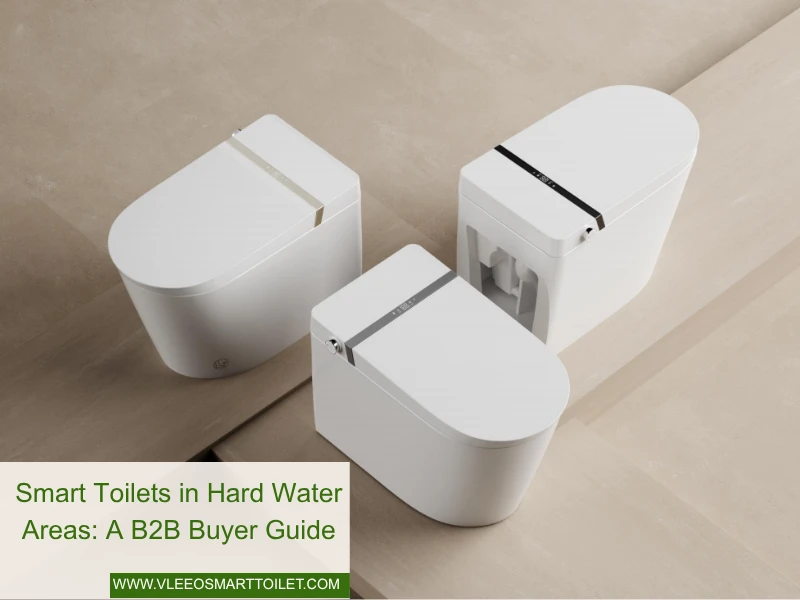
Smart Toilets in Hard Water Areas: A B2B Buyer Guide
Smart toilets in hard water areas can work well, but buyers should not treat water quality as an after-sales question. It belongs in model selection, sample testing, manual preparation, and service planning.
VLEEO sometimes hears the problem in a familiar order. A distributor says that when they first started smart toilet with another factory, the first samples performed normally. Months later, customers in one city report white deposits around outlets, slower nozzle movement, or a spray that no longer feels as even. The product may not have one dramatic failure. Instead, mineral buildup has been developing quietly where water repeatedly passes, heats, or dries.
The useful response is not to label every complaint a product defect or to promise that one small filter will solve every water problem. A better response is to understand the local water, identify the exposed components, and agree on a realistic maintenance system before the range is launched.
Hard water is a market condition, not a product feature
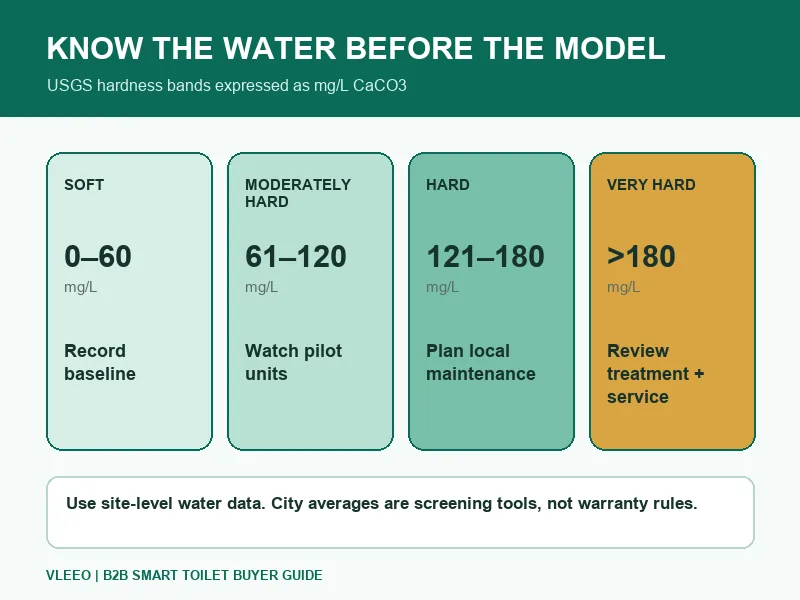
Water hardness mainly comes from dissolved calcium and magnesium. The U.S. Geological Survey hardness guide classifies water expressed as calcium carbonate as soft at 0–60 mg/L, moderately hard at 61–120 mg/L, hard at 121–180 mg/L, and very hard above 180 mg/L.
Those bands are useful for screening, but they are not a universal smart-toilet warranty rule. A city average may not describe one building, and a private well can differ from the nearest municipal supply. USGS itself advises using local utility, health-agency, or property-level information for local decisions.
For importers, this changes the first question. Instead of asking, “Does this smart toilet work with hard water?” ask: “What is the measured hardness at the installation site, what other water conditions are present, and what maintenance does this exact model require?”
That is the right starting point for smart toilets in hard water areas because hardness affects the complete water path, not the ceramic appearance alone.
For smart toilets in hard water areas, the water report should travel with the project brief instead of remaining only with the building operator.
Why mineral scale matters inside a smart toilet
Hard water becomes visible when droplets dry and leave pale deposits on a faucet or bowl. Inside a smart toilet, the same mineral-forming tendency can matter in smaller passages and on heated surfaces.
USGS explains that calcium and magnesium can form scale on pipes and especially on hot heat-exchanger surfaces, restricting flow and reducing heat-transfer efficiency. The EPA WaterSense water-softener guide likewise notes that scale can affect plumbing valves, fixtures, water heaters, and other appliances.
A smart toilet is not identical to a household water heater, but the sourcing lesson is relevant. Water may pass through an inlet screen, valve, pressure-control section, heater, distribution path, and nozzle assembly. The exact construction varies by model. When mineral deposits develop, the buyer may see changes in flow, temperature stability, spray pattern, valve behavior, or cleaning frequency.
This does not mean every white mark proves internal damage. It means a supplier and buyer should discuss the water path before promising long service intervals.
When reviewing smart toilets in hard water areas, buyers should connect visible deposits with measured water conditions before drawing conclusions.
Read complaint patterns before replacing parts
A distributor working with smart toilets in hard water areas needs a simple way to separate likely water-condition symptoms from electrical, installation, or component faults.
| What the service team sees | Possible water-related explanation | What to verify first |
|---|---|---|
| White crust near a nozzle or outlet | Evaporated mineral deposits | Local hardness result and cleaning history |
| Spray becomes uneven or weaker | Deposit or debris may be restricting a small passage | Inlet screen, nozzle care steps, and site pressure |
| Wash temperature feels less stable | Flow or heat-transfer conditions may have changed | Flow condition, heater path, and model fault code |
| Valve or filter needs frequent attention | Water contains hardness minerals, sediment, or both | Water analysis; do not assume hardness alone |
This table is a triage aid, not a diagnosis. Weak spray can also come from low inlet pressure, a partly closed angle valve, a bent hose, debris after construction, an incorrect setting, or a failed component. Temperature changes can have electrical or control causes. Service teams should follow the model manual and supplier procedure rather than applying acid or dismantling heated parts without approval.
Do not confuse hardness with every water problem
One of the most expensive sourcing mistakes is using “hard water” as a label for any difficult water supply. Hardness, sediment, iron, total dissolved solids, chlorine, pH, and inlet pressure describe different conditions.
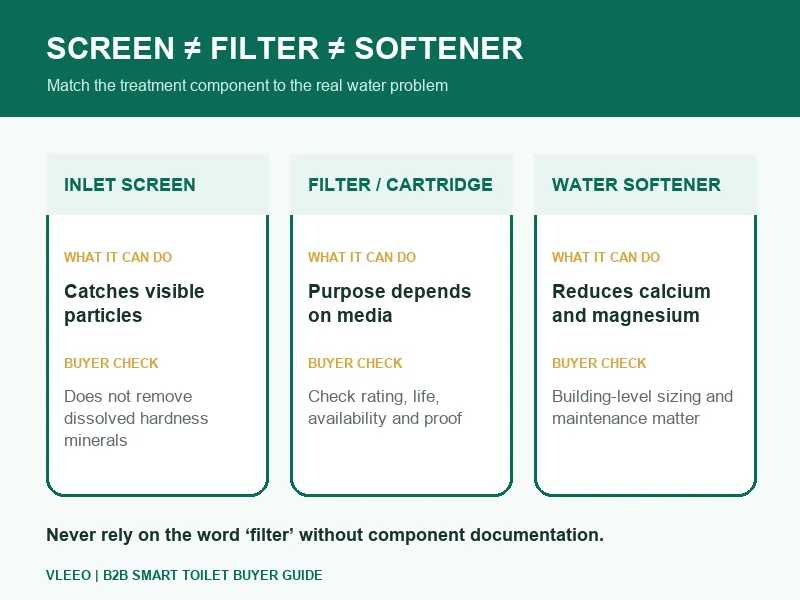
For example, a basic sediment screen may catch particles but will not necessarily remove dissolved calcium and magnesium. A carbon filter may address some taste, odor, or chlorine concerns but is not automatically a water softener. A softener that exchanges calcium and magnesium ions can reduce hardness, but it must be selected and maintained as part of the building’s water-treatment system.
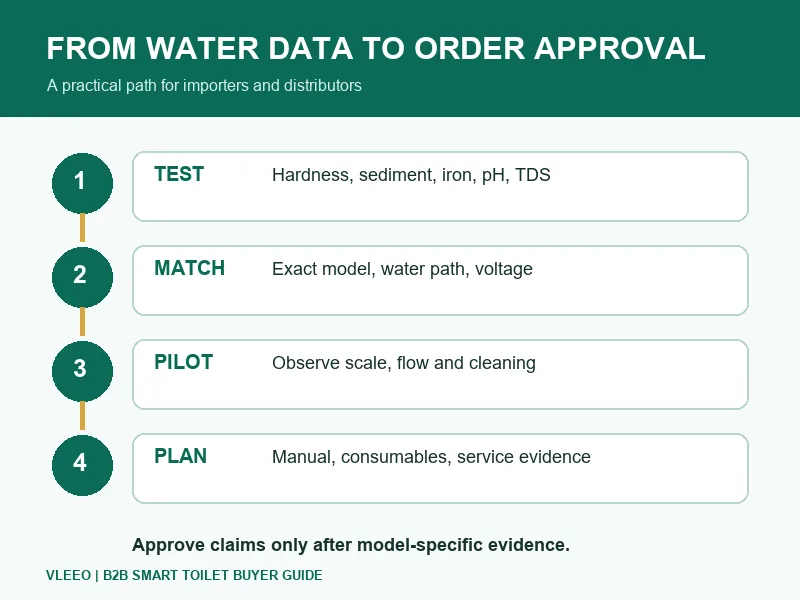
Before approving smart toilets in hard water areas, buyers should collect:
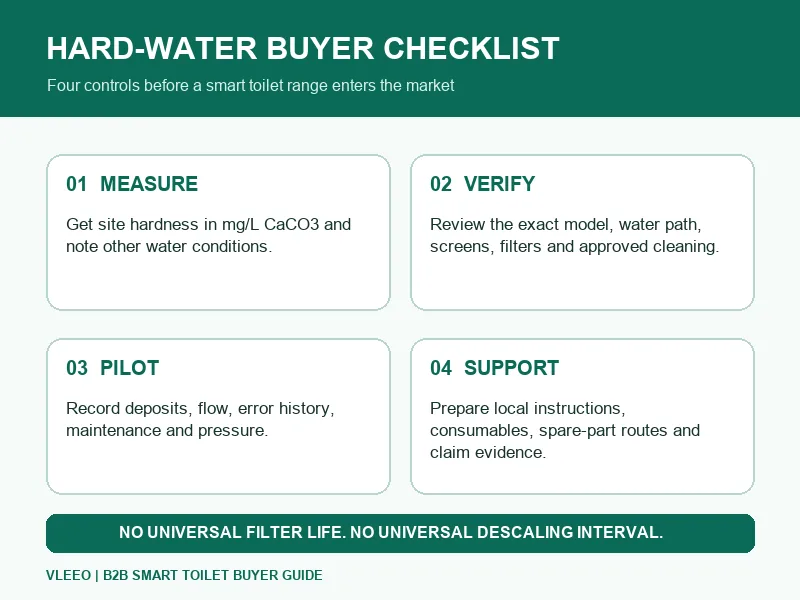
- A recent local water-utility report or a site test showing hardness in mg/L as CaCO3, plus any relevant sediment, iron, pH, or TDS information.
- The actual inlet-pressure range and whether the project uses municipal water, a private well, storage tanks, pumps, or building-level treatment.
- The exact smart-toilet model and market configuration, including voltage, heater type, water path, included screens or filters, and approved maintenance instructions.
This small evidence pack is more useful than asking for a general “hard-water model.”
It also gives suppliers a fair basis for comparing smart toilets in hard water areas during sample review.
Questions to settle before sample approval
The best time to discuss mineral scale is before the sample is approved. The supplier can then answer against the real configuration, and the buyer can test the product under conditions closer to the target market.
Ask the supplier to identify which water-contact parts are user-cleanable, which are technician-serviceable, and which must not be opened locally. Confirm how the inlet screen is accessed, how the nozzle is cleaned, whether any replaceable cartridge is included, and what signs should trigger service rather than routine cleaning.
Also ask for the approved cleaning agent and concentration, if descaling is allowed. “Use vinegar” is not a safe universal instruction. Acids can react differently with seals, plated surfaces, plastics, heater materials, adhesives, and coatings. The model manual and supplier guidance should control the procedure.
Finally, agree on the proof needed during a pilot. Photos of white deposits, the water-test result, installation date, maintenance record, pressure reading, fault display, and a short video of the spray often tell the factory more than a message saying “water is bad.”
That evidence turns smart toilets in hard water areas into a testable sourcing decision rather than a vague sales claim.
Build maintenance around the local water, not a global calendar
There is no honest universal statement that every filter should be replaced after the same number of months. A low-use showroom on moderately hard municipal water is different from a busy hotel room supplied by a hard-water well.
For smart toilets in hard water areas, VLEEO recommends that buyers begin with the exact manual, observe the pilot units, and adjust the local service interval from evidence. The first review can record deposit appearance, inlet-screen condition, spray consistency, error history, and customer cleaning behavior.
The buyer can then turn that evidence into a short local service card. It should explain normal exterior cleaning, user-accessible nozzle care, inlet-screen inspection, approved cartridge replacement if applicable, the symptoms that require a technician, and the information needed for a warranty request.
This approach protects both sides. Customers receive instructions suited to their water conditions, while distributors avoid promising a maintenance-free product in a market where other water appliances also require scale management.
A local service card should name smart toilets in hard water areas directly so support teams understand why the instructions differ.
Filters and softeners must match the real problem
A filter icon on a product sheet can create false confidence. Buyers need to know what the supplied component actually does.
An inlet screen can protect against visible particles. A specialized cartridge may address selected contaminants or scale-forming conditions, depending on its media and rating. A building-level ion-exchange softener can reduce calcium and magnesium, but it brings its own sizing, regeneration, water-use, salt, blending, and maintenance decisions. EPA’s guide emphasizes choosing and maintaining water-efficient softeners rather than treating all systems as equal.
When planning smart toilets in hard water areas, do not ask only whether a filter exists. Ask what it is designed to remove, its rated conditions, replacement method, availability, cost, and whether the claim is supported by the component documentation. If the site already has water treatment, confirm the treated-water characteristics rather than assuming “softened” means ideal for every material.
For smart toilets in hard water areas, every treatment claim should match the filter or softener documentation.
Turn water knowledge into a stronger product launch
Hard-water planning is not only a technical precaution. It can become part of a distributor’s sales and service advantage.
A buyer who understands local water can choose a suitable pilot location, prepare clearer manuals, stock the right approved consumables, train service partners, and answer customer questions without guessing. The same work also helps the factory investigate complaints faster because both sides are using measurements and model-specific records.
For a new market launch, keep the process practical:
- Test representative site water and run pilot units long enough to observe deposits and cleaning needs.
- Confirm approved user maintenance, technician boundaries, consumables, spare-part routes, and evidence required for claims.
- Put local water notes in distributor training and after-sales materials without turning them into unsupported performance guarantees.
That is how smart toilets in hard water areas move from a vague risk to a manageable part of product planning.
It also gives smart toilets in hard water areas a clearer service story for distributors, installers, and property teams.
FAQ
Q1. Can a smart toilet be used with hard water?
Often yes, but suitability and maintenance depend on the measured water conditions and the exact model. Buyers should confirm the water path, filtration or screening components, approved cleaning procedure, and service interval before ordering.
The safest way to approve smart toilets in hard water areas is to combine the local test result with model-specific instructions.
Q2. Does a small toilet filter soften hard water?
Not necessarily. A screen may remove particles, while a carbon or specialty cartridge has a different purpose. Removing dissolved calcium and magnesium normally requires a treatment method specifically designed for hardness. Check the component specification instead of relying on the word “filter.”
This distinction matters when buyers compare smart toilets in hard water areas.
Q3. How often should a smart toilet be descaled?
There is no universal interval. Follow the model manual and supplier instructions, then use pilot-unit observations and local water results to set the service schedule. Do not introduce an acid or cleaner into internal components unless the procedure is approved.
Q4. What should an importer send VLEEO for model review?
Send the target country, selected model or function list, hardness result in mg/L as CaCO3, other relevant water-test data, inlet-pressure information, project type, expected usage, voltage, and the planned local service method.
This information helps VLEEO review smart toilets in hard water areas without assuming that every site is the same.
Review the water conditions before locking the order
If your market has hard or very hard water, send VLEEO the local water report together with the project conditions and required functions. We can review the information against the proposed model, identify questions that need sample testing, and help your team prepare a more realistic maintenance and after-sales plan before production.