-
Guxiang Town, Chaozhou City,Guangdong Province, China

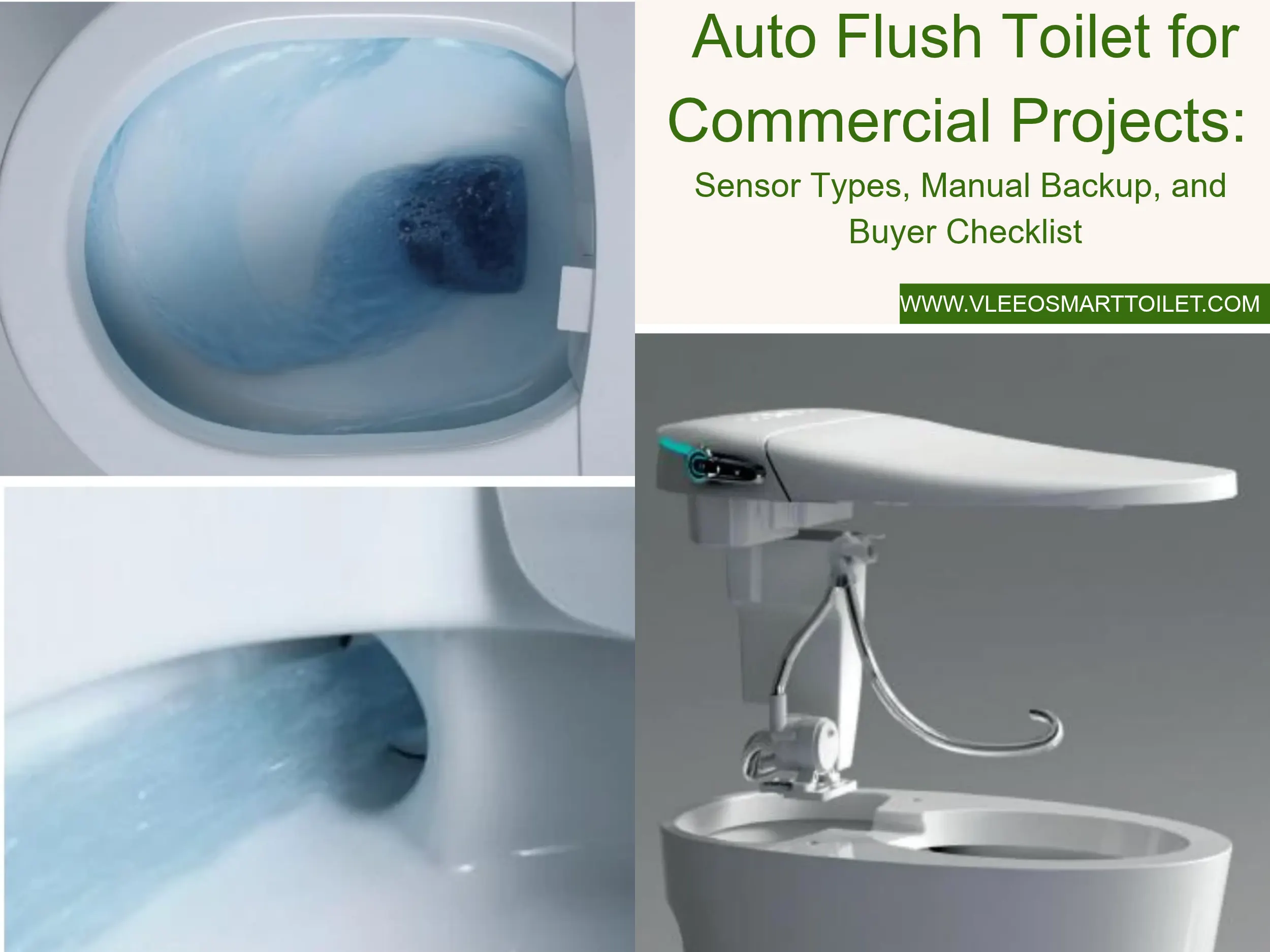
Auto Flush Toilet for Commercial Projects: Sensor Types, Manual Backup, and Buyer Checklist
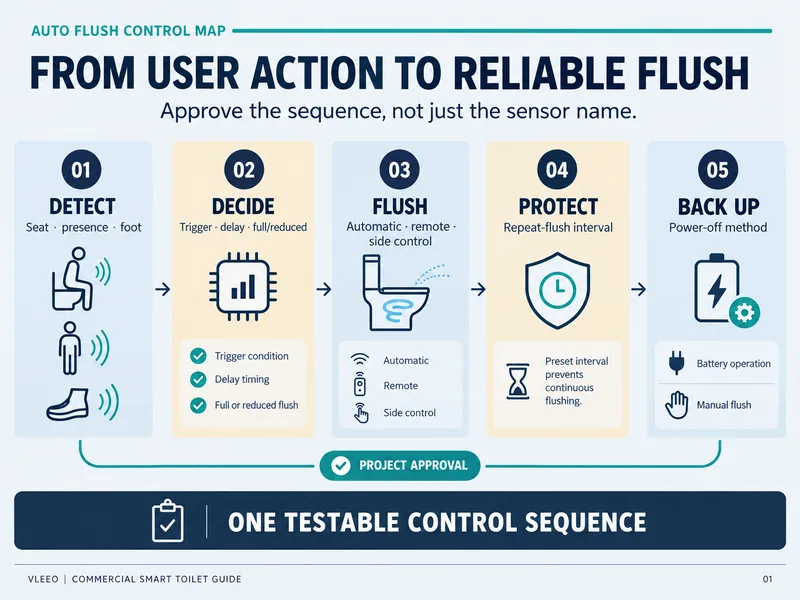
You stand up from the sample, take two steps, and hear the flush. Good. Then you step back to pick up your phone and the toilet reacts again. That second sound changes the discussion. An auto flush toilet can look perfect on a feature sheet, yet the project result depends on when it senses a user, how it decides the visit has ended, and what happens when automatic control is not available.
For a hotel, apartment, showroom, or public project, “auto flush” is not a complete specification. It is the start of a control sequence. A buyer needs to understand that sequence before approving a sample or comparing quotations.
Auto Flush Toilet: The Feature Name Hides the Part that Matters
Two smart toilets may both carry the same auto-flush label. One may flush after the seat sensor confirms that a seated user has left. Another may add foot-sensor control. A third may change between full and reduced flushing according to how the toilet was used. The user sees one simple result, but the product team is buying sensors, timing rules, controls, and backup behavior.
This is why a feature comparison often fails. It tells you that automatic flushing exists, but not what the toilet will do when someone stands nearby, opens the lid without sitting, returns to the sensing area, presses the remote, or loses power.
The U.S. EPA makes a similar point for commercial facilities: automatic sensors that are poorly set, operated, or maintained can cause double or “phantom” flushing and increase water use. Its WaterSense at Work guidance for toilets is a useful reminder that touch-free control is only valuable when the logic is stable.
Auto Flush Toilet Starts with the Trigger, not the Sensor Name
“Infrared,” “seat sensor,” and “foot sensor” describe inputs. They do not tell you the final action. During sample approval, follow the user from approach to departure.
A typical full-electric smart-toilet configuration can combine several routes:
- automatic flushing after the seated user leaves;
- foot-sensor flushing for a standing user or touch-free command;
- a flush key on the remote control;
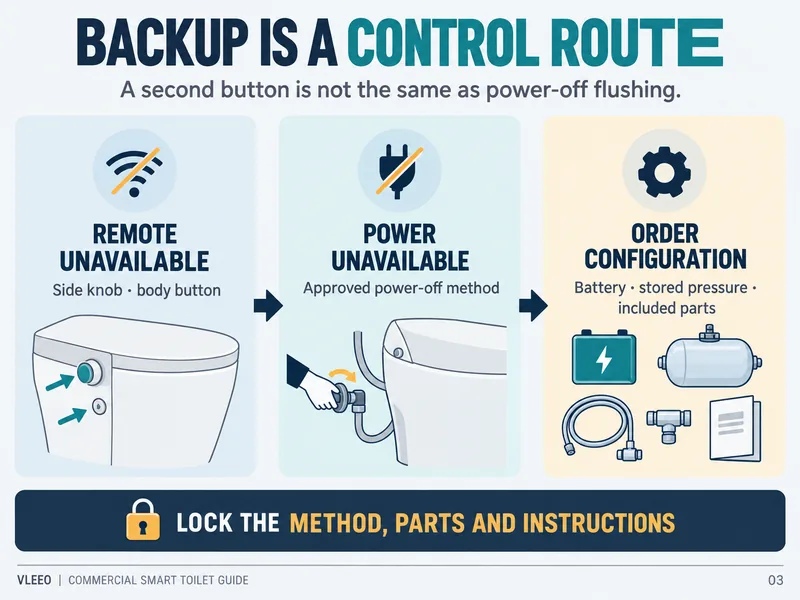
- a side knob or body button that works when the remote is unavailable;
- a separate power-off flushing method.
Those routes need to agree with each other. If the automatic sequence is delayed, the user must still understand whether pressing the foot sensor or side control will flush immediately. If the toilet has reduced and full flush modes, the quotation must state how each mode is selected.
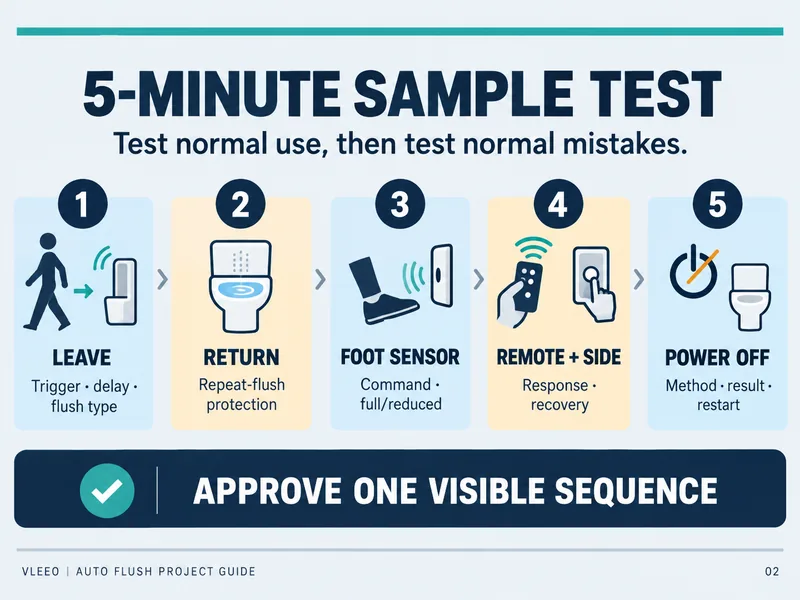
An Auto Flush Toilet Sample Test Takes Five Minutes
Do not begin with a long laboratory script. Begin with normal mistakes. People hesitate, step back, press a control twice, or leave before the toilet has finished its sequence.
| No. | Action | What the buyer records |
|---|---|---|
| 1 | Sit for a normal visit, stand, and walk away | Trigger point, delay, flush type, lid action |
| 2 | Step back into the sensing area | Whether repeat-flush protection works |
| 3 | Use the foot sensor without sitting | Exact command and whether it uses full or reduced flush |
| 4 | Command a flush by remote and side control | Response, priority and recovery after a missed command |
| 5 | Disconnect normal power and follow the approved backup method | Parts needed, steps, flush result and restart behavior |
The aim is not to make every configuration behave the same way. It is to make the approved behavior visible. Your instruction sheet, carton contents, quotation and sample should all describe the same sequence.
Auto Flush Toilet’s Manual Backup
Project buyers often ask whether a smart toilet can flush without its remote. That is one backup question, not the whole question.
A side knob or body button helps when the remote is lost, unpaired, or out of battery. It does not automatically prove that the toilet can flush during a building power outage. Power-off flushing may use stored water pressure, an internal reserve, a battery-assisted procedure, or another design. The exact method belongs to the selected configuration.
VLEEO’s documented full-electric CL-630 and CL-721 platform sheets include automatic, manual, and power-off flushing together with remote, foot-sensor, and side-control options. A separate manual for one documented VLEEO configuration also defines automatic departure flushing, foot-sensor operation, remote/knob flushing, a repeat-flush interval, and a battery-assisted power-off procedure. These records show why the backup route can be designed into the product, but they do not make every build identical.
For an order, lock the actual voltage, trapway, flush hardware, battery or power-off method, control parts, and instructions. A model name alone is not enough.
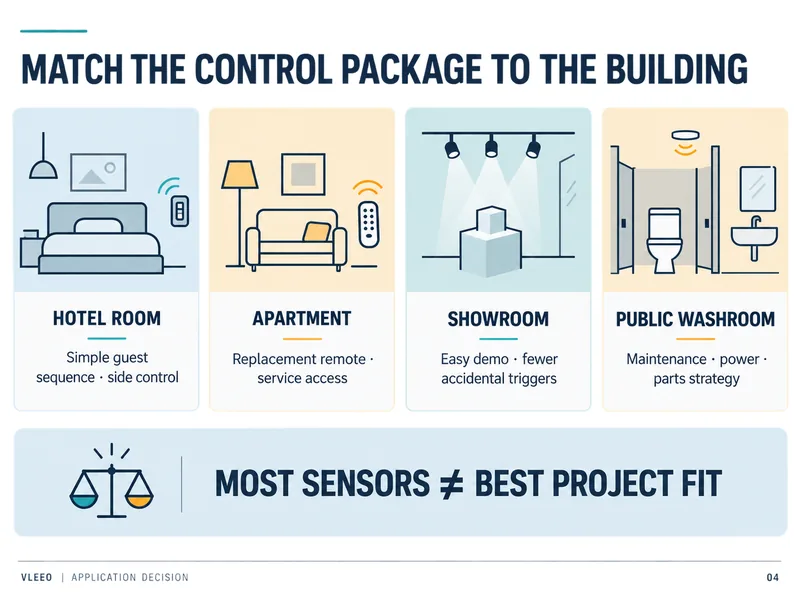
The best control package depends on the building
In a hotel room, a guest needs a sequence that is easy to understand without training. The side control matters because the remote may be placed badly or removed. In an apartment project, the property team may care more about replacement remotes, service access, and a clear reset procedure. In a showroom, the foot sensor must be easy to demonstrate without causing an accidental flush every time someone walks past.
High-traffic public washrooms add another question: is an integrated smart toilet the right service model for that location? Some projects are better served by simpler commercial fixtures. The answer depends on user profile, maintenance access, electrical provision, parts strategy, and the experience the project is trying to sell.
That is a commercial choice, not a contest to install the most sensors.
Water efficiency still belongs to the exact model
Automatic control does not create a water-efficiency certification by itself. In the United States, WaterSense criteria apply to exact toilet models and tested flush performance. Use the EPA WaterSense product search when a project requires a labeled model, and match the listing to the ordered configuration.
For projects outside the United States, use the applicable local plumbing and electrical route. Keep the sensor story separate from certification evidence. Both matter, but one cannot stand in for the other.
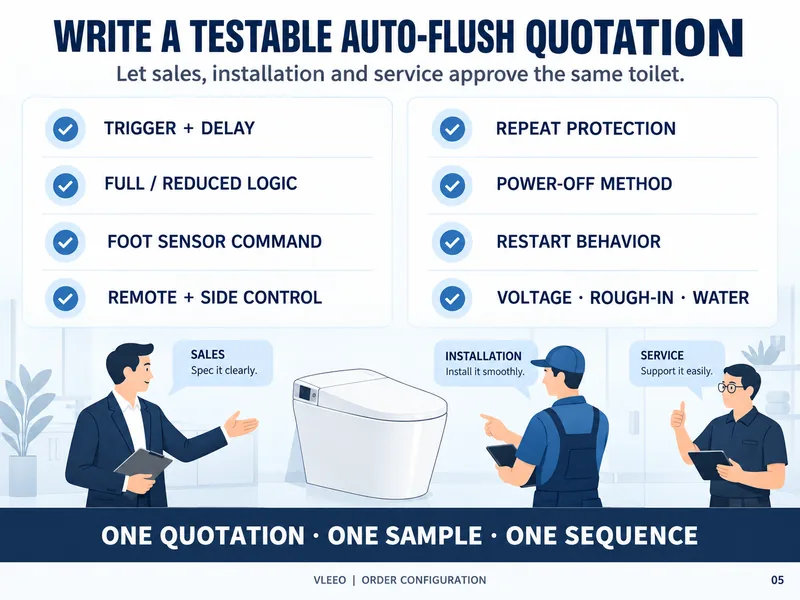
Write the quotation so another team can approve it
A clean quotation should let the buyer, installer, sales team, and service team picture the same toilet. Add a short control schedule rather than one line that says “auto flush.”
- automatic trigger and delay;
- full/reduced flush selection logic, if applicable;
- foot-sensor command;
- remote and side-control command;
- repeat-flush protection;
- power-off flushing method and included parts;
- restart behavior after power returns;
- voltage, plug, rough-in, drainage and water-pressure conditions.
VLEEO treats its models as configurable platforms. Browse the smart toilet range, then send the project conditions before fixing the control package.
FAQ about Auto Flush Toilet
1. Does an auto flush toilet always use a seat sensor?
No. Products may use seat sensing, presence sensing, foot sensing, or a combination. Ask for the complete trigger sequence rather than relying on the sensor label.
2. Can an auto flush toilet flush during a power outage?
Some configurations include a power-off method, but the design varies. Confirm the approved procedure, required battery or stored-water arrangement, included parts, and expected flush result.
3. Why is a side knob useful if the toilet has a remote?
It gives the user a control route when the remote is missing, out of battery, or difficult to reach. It does not by itself prove power-off flushing.
4. Can a foot sensor replace automatic departure flushing?
It can provide a touch-free command, but it serves a different user action. A project may use one or both routes according to its control plan.
5. How can buyers prevent double or phantom flushing?
Approve trigger distance, delay, repeat protection, and recovery through a real sample test. Keep installation and maintenance instructions consistent with the approved settings.
6. What should I send VLEEO for an auto-flush quotation?
Send the target country, project type, expected users, drainage and rough-in, voltage, water conditions, preferred control routes, power-off requirement, certification needs, and sample quantity. Contact VLEEO with that project brief so the quotation describes one testable configuration.