-
Guxiang Town, Chaozhou City,Guangdong Province, China

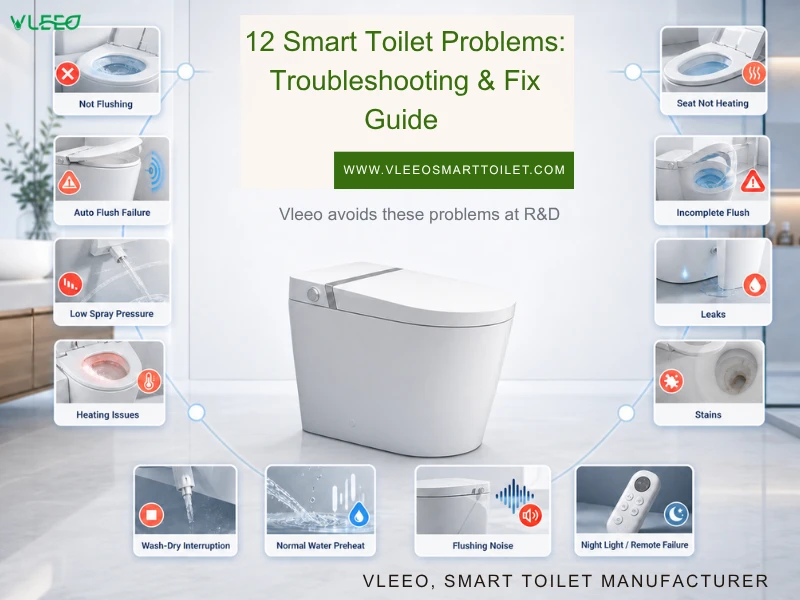
12 Smart Toilet Problems: B2B Troubleshooting & Fix Guide | Vleeo
If you are a wholesaler, retailer, engineering contractor, or importer dealing with smart toilet problems, you have probably gotten that phone call from a client: “The toilet is acting weird.”
Smart toilet problems are more common than most people expect — but the good news is that the vast majority of them have straightforward causes and even simpler fixes. Understanding what actually goes wrong with these units is the first step to resolving issues quickly and keeping your clients happy.
In this guide, we break down the 12 most common smart toilet problems from the perspective of a manufacturer who has fielded thousands of service questions from B2B partners across 52 countries. We cover the cause, the fix, and what you can do to reduce these calls for good.
Whether you are stocking smart toilet problem solutions for resale, installing them on a project, or managing inventory for a distribution line, this guide is written for you.
Before You Read Anything Else — Two Stories You Need to Hear
Most of what this article covers makes a lot more sense when you understand where these smart toilet problems actually come from. So before we get into the technical list, let us share two real situations that changed how we think about smart toilet after-sales support.
Case Study 1: The Problem We Thought Was Ours — Until It Wasn’t
Before we started working with a new B2B buyer, they asked us the question we hear from nearly every first-time smart toilet purchaser:
“Won’t you spend all your time dealing with after-sales support?”
It is a fair concern. Smart toilets have electronics, plumbing, sensors, and remote controls. On paper, there are many things that could go wrong.
After two years of working together, that same buyer shared something surprising:
“Honestly, the after-sales on your toilets has been minimal. Our team got up to speed quickly because of the training and documentation you provided upfront.”
Where they did run into trouble — repeatedly — was not with the product. It was with their end users: guests and residents who had never used a smart toilet before and simply did not know how to operate one. According to the HomeAdvisor smart home research, the majority of smart bathroom fixture complaints in hospitality settings trace back to user unfamiliarity rather than mechanical failure.
- Guest checking in at 11 PM: “The toilet won’t flush.” Maintenance goes down. The power plug was not connected after the room was cleaned.
- New resident: “The spray never comes on.” Service call. The angle valve was still in the off position from installation.
- Hotel staff: “The seat is not warming up.” Another call. ECO mode was accidentally left on from the previous guest’s settings.
These are not product failures. They are onboarding gaps. And they are not the property manager’s problem to solve alone — they are the kind of smart toilet problems that good product knowledge, clear documentation, and a short video can prevent entirely.
That is why every Vleeo B2B buyer receives not just a technical manual, but a complete product knowledge package: installation guides, end-user operation videos, maintenance schedules, and a direct line to our technical team. Because the after-sales experience should start before the product is even installed.
Case Study 2: The Buyer Who Finally Understood Why Prices Differ
A purchasing manager at a real estate developer was comparing three smart toilet suppliers. She had a budget to hit and kept getting quotes that seemed 20-30% higher than she expected for what looked like similar products.
She called us frustrated: “Why is your toilet so much more expensive?”
We asked her one question: “Does the other quote include a dedicated inlet filter valve, braided stainless steel supply hoses rated for the heating system, and a GFCI power cord — or are those add-ons?”
Silence on the line.
She went back to the other quote. The price looked low because it was. The filter valve was a $40 optional extra. The correct hoses were $25 add-ons. The GFCI plug was not standard. Once she factored in getting those units to the same specification, the prices were nearly identical.
But the higher cost was not the accessories. It was what happened after installation. When Hunker’s plumbing maintenance guide notes that smart bathroom fixtures are among the most commonly misinstalled products in new developments — largely because buyers did not compare what was included in the base price — it confirms what we see in the field every day.
- A cheap inlet valve without a filter clogs.
- A standard hose not rated for the heating system’s pressure range leaks.
- A unit without proper GFCI grounding trips constantly.
Each of these generates a service call, a maintenance ticket, and — in a hotel — a guest complaint that ends up on a review platform. The smart toilet problems that appear most often in the field are rarely product defects. They are the result of buying decisions made without understanding the full specification picture.
At Vleeo, we build our pricing around complete specifications. Every unit includes the correct angle valve with filter, rated supply hoses, a GFCI power cord, and a remote control. No surprises at delivery. No hidden costs after installation.
About Vleeo: Vleeo is a sub-brand of Cleanman — a sanitation equipment manufacturer established in 2002 — specializing exclusively in smart toilets. While Cleanman has two decades of manufacturing experience in sanitary equipment, the Vleeo brand was built specifically to design, manufacture, and support electronic smart toilet products for the global market.
The 12 Most Common Smart Toilet Problems
Now that you understand where most smart toilet problems actually come from, here is the technical reference — organized so you and your clients can find and fix any issue quickly.
Looking for a specific smart toilet troubleshooting topic? Jump to the table below or use the Q&A section at the bottom for deeper dives into each category of issue.
| Normal — water warming system initializing before the wash cycle starts | Problem | Most Common Cause | Quick Fix |
|---|---|---|---|
| 1 | Toilet doesn’t flush | Angle valve closed | Turn angle valve counter-clockwise to open |
| 2 | Auto flush not working | Auto flush setting is OFF | Enable via remote control or knob |
| 3 | Spray nozzle won’t activate or pressure is low | Clogged inlet filter or low water pressure setting | Clean filter; check water pressure setting on remote |
| 4 | Water isn’t warm | Temperature set to lowest level or ECO mode active | Adjust water temperature; exit ECO mode |
| 5 | Seat isn’t warm | ECO mode, standby mode, or 10-minute auto temp drop | Exit ECO mode; sit back and wait 5 minutes |
| 6 | Waste won’t flush completely | Filter blockage, wrong angle valve, or concurrent water use elsewhere | Clean filter; use supplied angle valve; avoid running other water fixtures during flush |
| 7 | Water leaking from base or connections | Loose plumbing connection | Tighten connection nuts; if persists, shut off water and contact service |
| 8 | Black or pink stains on the bowl | Mineral deposits, ammonia from urine, or bacterial growth | Clean with non-abrasive neutral toilet detergent |
| 9 | Wash or dryer stops mid-cycle | Seat sensor lost contact — user shifted forward or sat on edge of seat | Sit back fully on the seat with weight centered |
| 10 | Water comes out of spray nozzle when seated but not using wash | Normal — water warming system initializing before wash cycle starts | No action needed; this is normal operation |
| 11 | Gurgling sound during flush | Normal — air in the siphonic drain system | No action needed; normal for siphonic jet flush design |
| 12 | Night light or remote control not working | Function set to OFF; dead or incorrectly installed batteries | Enable via remote; check battery orientation; replace batteries |
Smart Toilet Problems in Depth: Your Top 7 Questions Answered
Q1: What is the most common smart toilet problem — and is it actually a defect?
The most reported smart toilet problem across every smart toilet manufacturer is “the toilet won’t flush.” In our experience handling after-sales support for thousands of units in hotels and residential buildings, the angle valve was closed in the vast majority of cases.
Not a defective pump. Not a broken circuit board. Just a valve that got bumped during installation or cleaning and nobody thought to check.
This is exactly why we encourage every B2B buyer to include an angle valve check in their installation commissioning checklist — and why we provide a short video walkthrough for property managers. It takes five minutes and prevents a wave of “the toilet is broken” calls on move-in day. Understanding this pattern of smart toilet problems — and training your clients to check the simple things first — is the single most effective thing you can do to reduce after-sales volume.
Q2: How do I reduce smart toilet service calls for my clients?
Three things work better than anything else when it comes to preventing smart toilet problems:
- Brief orientation for end users: A QR code or a small card near the toilet — linking to a one-page visual guide or short operation video — prevents the majority of “is this broken?” calls from hotel guests and residential tenants. When end users understand how to operate the unit, the number of service tickets drops dramatically.
- Regular filter maintenance: Schedule quarterly inlet filter cleaning for all units, especially in buildings with older plumbing or hard water. A clogged filter causes both flushing failures and spray pressure issues — two of the most common smart toilet problems we see in the field.
- Standardize on one or two models: Maintenance is dramatically simpler when your technical team learns one product well. We help B2B buyers select the right model for their project type and provide training materials specific to that product.
Q3: Why does the smart toilet stop washing or drying mid-cycle?
As described in Case Study 1, this is almost always a seat sensor issue. Smart toilets use a sensor embedded in the seating surface to detect whether someone is present. If the user shifts forward, sits on the edge of the seat, or leans on the seat lid, the sensor loses contact and the unit stops the wash or drying function as a safety measure.
The fix is simple: sit back fully on the seat, with your weight centered. Educating end users about proper seating — through a posted guide or a brief check-in from hotel staff — eliminates this complaint almost entirely. It is a training problem, not a product defect — one of the many smart toilet problems that proper onboarding can prevent.
Q4: What is the real difference between a budget smart toilet and a quality unit?
As the story in Case Study 2 illustrates, the price difference is rarely about the brand name alone. It is almost always about what is included — or excluded — from the quoted price. When you encounter smart toilet problems in the months after installation, they almost always trace back to one of these component shortcuts:
- The angle valve: Quality units include a dedicated inlet angle valve with a built-in filter — specifically rated for the bidet heating system’s inlet pressure. Budget units often list this as an optional extra.
- The inlet filter: A PP filter on the water inlet catches sediment before it reaches the bidet waterways. Without this, mineral buildup causes nozzle clogs and pressure failures within months. The filter is a $5 component. A service call to clear a clogged installed unit costs $150-$300.
- Supply hoses: The heating element in a smart toilet operates at up to 1200W. The water supply hose must be braided stainless steel, rated for both pressure and temperature. Using a standard hose — which some budget suppliers ship by default — is a leading cause of water damage claims.
- Electrical safety: A proper GFCI-protected power cord is not optional. Units that ship with standard plugs and require a separate GFCI adapter are cutting corners on safety compliance.
When comparing quotes for your inventory or projects, always ask: “What is included — and what requires a separate purchase?” The total cost of ownership tells the real story — and it is the best predictor of how many smart toilet problems you will manage after installation.
Q5: Can smart toilets be installed by any contractor, or do they need a specialist?
For a single residential unit, a competent plumber can install a smart toilet following the manufacturer’s illustrated guide. The process is similar to installing a standard toilet, with two additional steps: connecting the water inlet with the correct angle valve, and plugging into a properly grounded, GFCI-protected outlet.
For commercial projects — hotels, apartment buildings, and developments — professional installation by a licensed plumber is strongly recommended. Per the American Society of Home Inspectors (ASHI) standards, any fixture connecting to both the water supply and electrical systems requires certified installation to meet code compliance in most US jurisdictions.
- Smart toilets contain more integrated electronic components than standard toilets and require careful handling during installation to avoid damaging the ceramic bowl or electronic mounting brackets.
- Commercial installations often involve multiple units, coordinated water pressure balancing, and electrical compliance. Professional installation protects your warranty and ensures correct commissioning from day one.
We work with a network of recommended installers in most major markets and can connect B2B buyers with vetted installation partners as part of the onboarding process.
Q6: How do I know if a smart toilet supplier is the right partner for my business?
If you are evaluating smart toilet suppliers for the first time — whether for a distribution line, a construction project, or a retail catalog — here are the questions we suggest asking every supplier:
- What does your after-sales support model look like? Is there a real person you can reach, or just an email form?
- Do you provide training materials and operation videos for end users — not just the technical manual?
- Are spare parts — filters, nozzles, remote controls — available and in stock after the initial purchase?
- What does your warranty actually cover, and for how long?
- Do you offer a product briefing or sample evaluation before a bulk order?
If a supplier cannot answer those questions confidently, that tells you something important before you sign anything. The right supplier will be as focused on preventing smart toilet problems before they happen as they are on resolving them after the sale.
Q7: What about problems that cannot be fixed with a guide?
Some issues — a failed heating element, a cracked ceramic bowl, a circuit board fault — are not DIY fixes. In those cases, good after-sales support matters more than the product specification sheet.
Ask before you buy: How long is the warranty? What is the typical turnaround on spare parts? Is there a technical contact you can reach directly, or is everything routed through a distributor?
We have been manufacturing and supporting smart toilets through the Vleeo brand since our first electronic model launched. We stand behind every unit with documented troubleshooting procedures, a responsive technical support team, and spare parts available long after the original purchase date. For B2B buyers building a long-term product line, that kind of continuity is not a luxury — it is the foundation of a good reputation with your own customers.
Smart Toilet Problems: Related Guides
- Smart Toilet Installation Guide: Step-by-Step Setup for B2B Installers — Everything you need to commission a smart toilet correctly the first time, including angle valve setup and GFCI outlet requirements.
- Smart Toilet Maintenance Schedule for Hotels & Property Managers — A ready-to-use preventive maintenance calendar that reduces smart toilet problems by up to 70% in managed properties.
Final Thoughts
Smart toilet problems are more manageable than they first appear. Most issues trace back to a small set of root causes: a closed valve, a clogged filter, a misunderstood setting. With a basic understanding of how these units work, the most common smart toilet problems can be diagnosed and resolved in minutes, without a service call.
The questions worth asking are not just about the product — they are about the supplier. What does their support look like after the sale? Do they help their B2B partners build real product knowledge? Are they still around when you need spare parts three years from now?
Because the best outcome is not just a product that works well out of the box. It is a smart toilet that still works well three years later, with a manufacturer standing firmly behind it — and a partner who understands how to keep their end users happy.