-
Guxiang Town, Chaozhou City,Guangdong Province, China

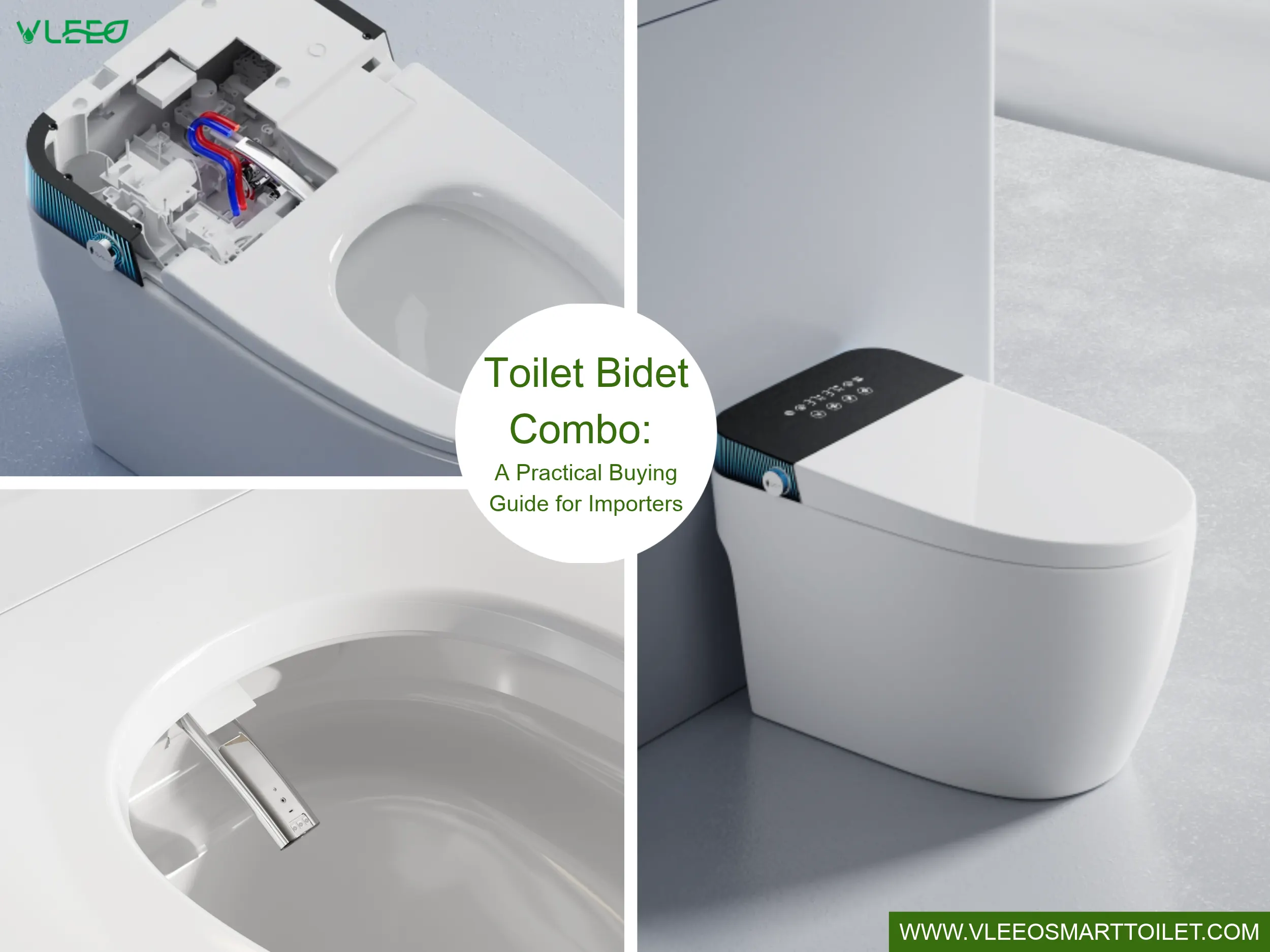
Toilet Bidet Combo: A Practical Buying Guide for Importers
A toilet bidet combo may appear as one short line on a quotation sheet. Then several samples arrive, and the differences are much larger than the product name suggests. One unit provides warm-water washing, seat heating, drying, and automatic flushing. Another uses the same integrated shape but keeps only basic wash and flush functions. A third looks premium in photos but needs water pressure or electrical conditions that the target bathroom cannot provide.
That is the real buying problem. An importer is not simply choosing a toilet with a bidet. The importer is choosing a complete product configuration for a price level, bathroom type, sales channel, and service plan.
This guide explains how to compare those configurations without letting a long feature list or a low unit price make the decision for you.
What a toilet bidet combo includes
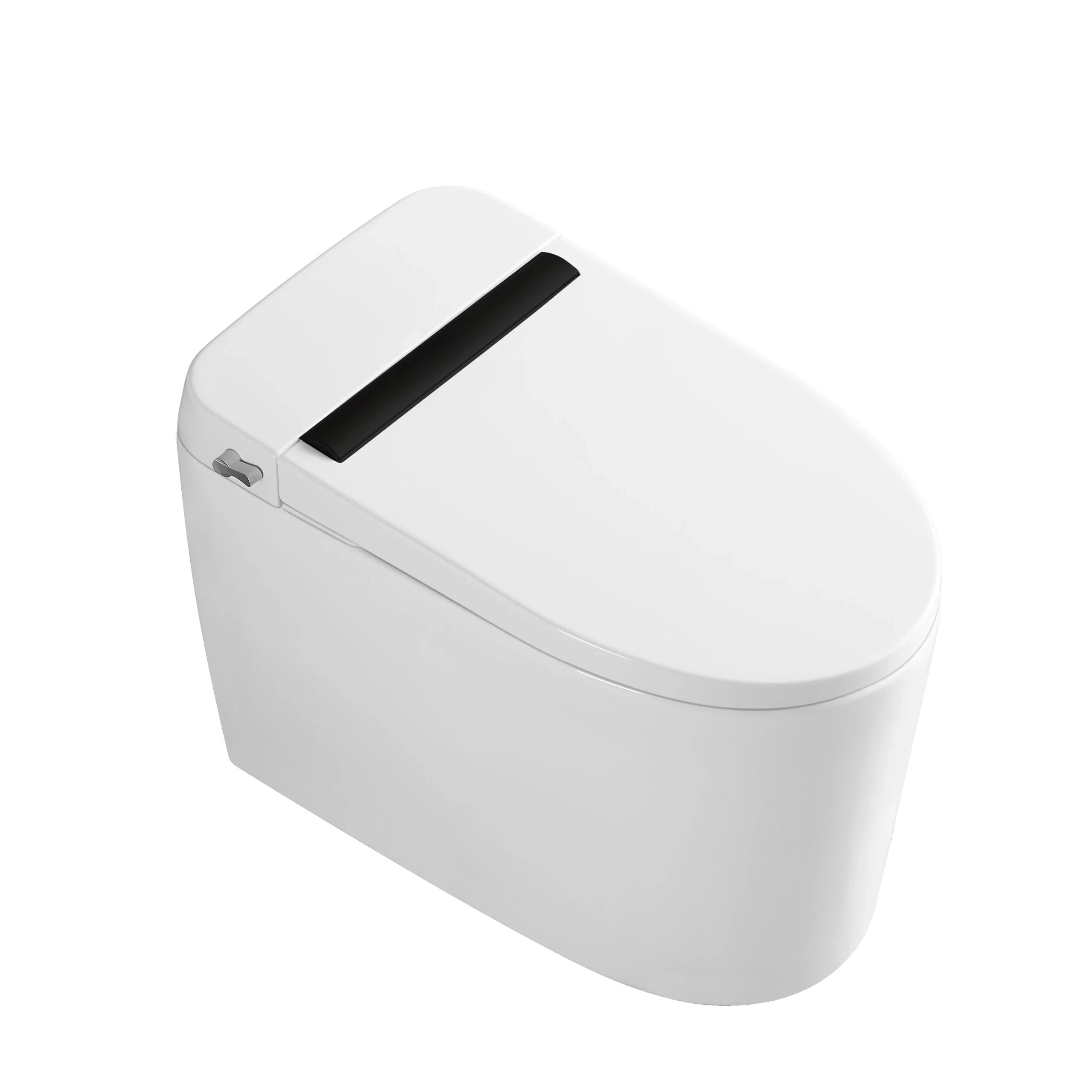
A toilet bidet combo combines the toilet bowl and personal washing system in one product. It normally has an integrated nozzle or wand that supplies water for rear or front washing. Electric versions may also heat the water and seat, provide warm-air drying, control the flush, open the lid, or run deodorizing and nozzle-cleaning cycles.
The term does not describe one fixed technical package.
At the basic end, a non-electric configuration can use water pressure and mechanical controls to provide room-temperature washing. At the other end, a full-electric model can manage most of the use cycle through sensors, a remote, and powered comfort functions. Both may be sold as a toilet bidet combo, yet they serve different buyers.
This is also different from adding a bidet seat or attachment to a conventional toilet. An attachment sits below the existing seat. A bidet seat replaces the seat but keeps the ceramic bowl. An integrated combo is designed as one complete fixture. TOTO’s WASHLET+ page shows how a matched toilet and bidet seat can conceal connections and create a coordinated system, while still remaining a distinct product format from a fully integrated unit (TOTO WASHLET+).
For a distributor, these formats should not be treated as interchangeable. They differ in installation work, packaging size, product price, spare parts, showroom presentation, and the amount of the bathroom that must be replaced.
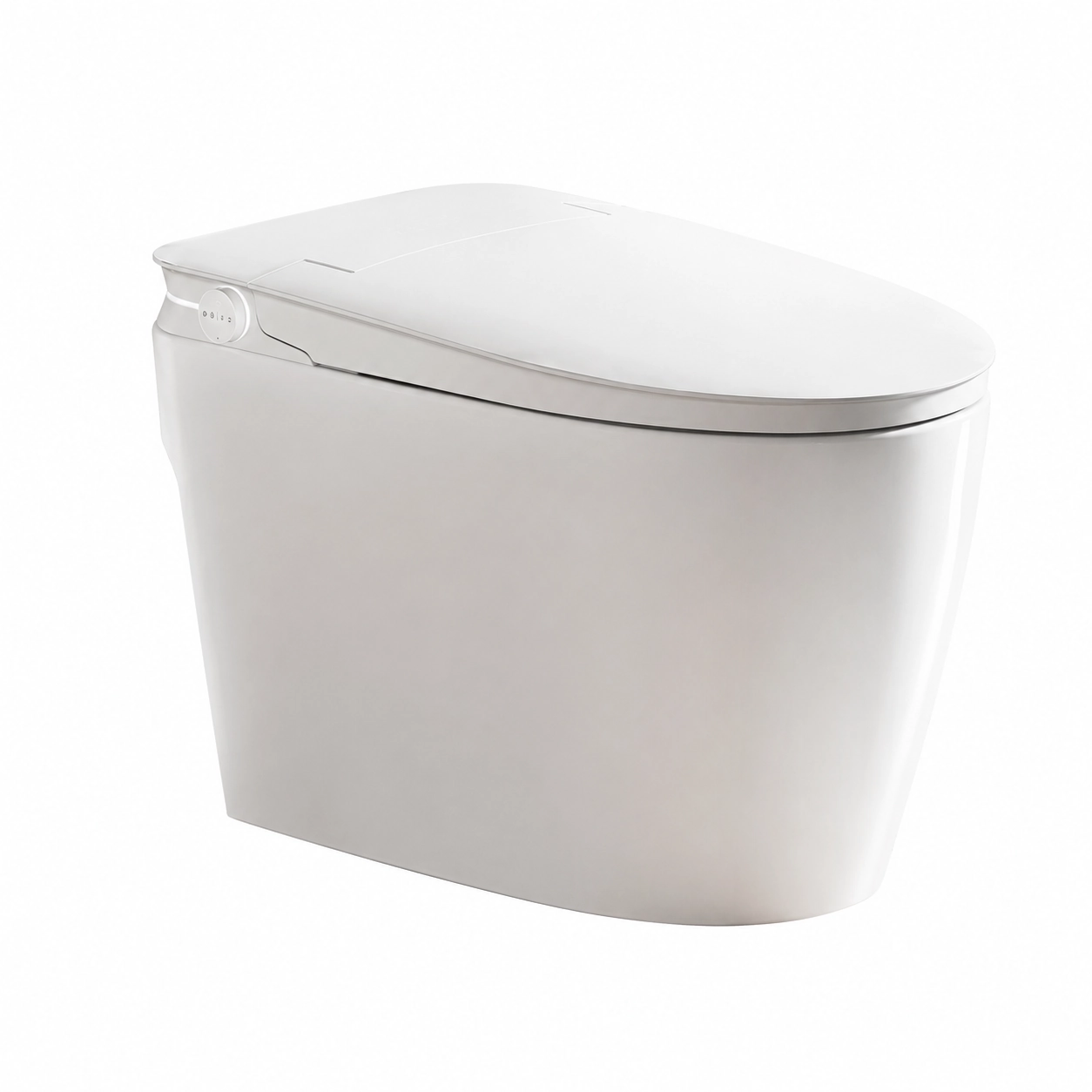
Start with the buyer, not the feature list
Imagine that your sales team receives two requests in the same week. A retailer wants an attractive model that can demonstrate a complete wash-and-dry cycle. A project contractor wants a dependable product for apartments where the electrical and drainage drawings are already fixed.
The same model may not suit both requests.
The retailer needs functions that a customer can understand in a few minutes. Stable washing, seat heat, drying, clear controls, and a visible automatic function may help the display. The contractor may care more about outlet position, voltage, water pressure, rough-in, service access, and repeatable installation across many rooms.
Before comparing prices, define four things:
- Who will buy or specify the product?
- What bathroom conditions are already fixed?
- Which functions create a clear reason to pay more?
- Who will install, explain, and service the product locally?
These questions prevent a common mistake: buying the largest function list and discovering later that the product is difficult to sell or support.
How to compare toilet bidet combo configurations
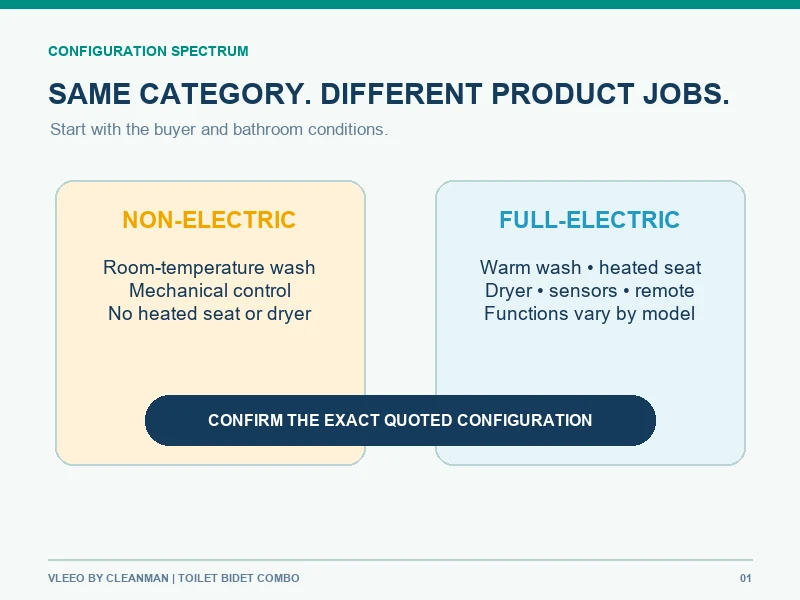
The first useful split is between non-electric and full-electric configurations.
A non-electric unit does not need a power outlet for washing or basic operation. It usually uses room-temperature water and mechanical controls. This can fit renovation markets, more economical ranges, or bathrooms where adding protected electrical power would raise project cost. It does not provide powered functions such as seat heating or warm-air drying.
A full-electric unit can offer a more complete routine. Depending on the model, it may include instant water heating, adjustable temperature and pressure, a heated seat, warm-air drying, automatic flushing, sensors, a remote, a side control, night lighting, or deodorization.
Do not assume that every electric model includes every function. Do not assume that two functions with the same name perform in the same way either. Dryer temperature, airflow, wash adjustment, sensor range, and control logic all affect the user experience.
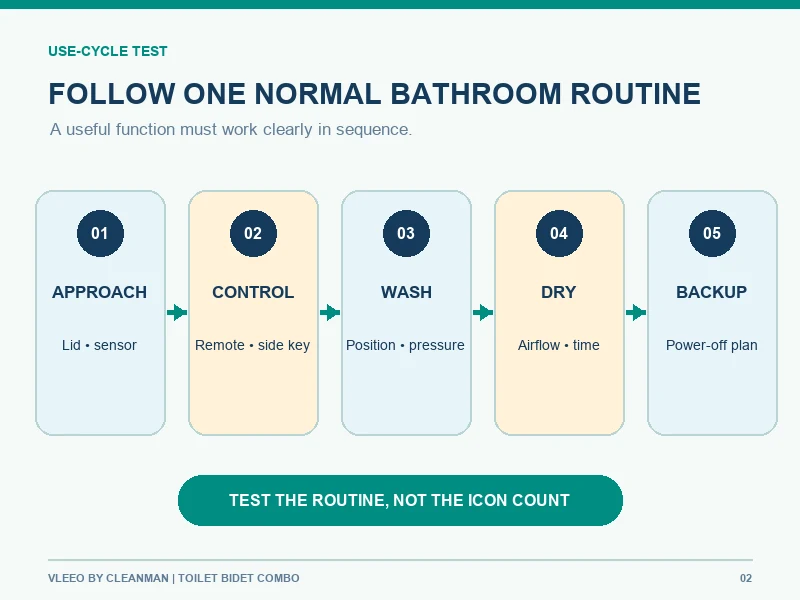
The best comparison follows one normal use cycle:
- How does the user open and control the toilet?
- How quickly does washing begin?
- Can water temperature, pressure, and nozzle position be adjusted?
- Is the dryer useful, or does it only add a line to the specification?
- What happens if the remote is missing or the power is off?
- Can a new user understand the controls without a long explanation?
This turns a feature list into a practical product test.
Installation conditions can eliminate a model before price matters
A toilet bidet combo connects ceramic, water, drainage, and sometimes electricity. Those systems must be reviewed together.
Start with the outlet. A floor-outlet toilet and a wall-outlet toilet use different drainage arrangements. For a floor outlet, the rough-in is commonly measured from the finished wall to the center of the drain. For a wall outlet, the height, direction, and connector details become important. The drawing must match the actual configuration being quoted.
Then check the water supply. Some flushing systems depend more directly on incoming pressure. Others use a built-in tank, pump, or air-assisted structure. A supplier should state the required pressure range for the exact model. A general statement such as “works with low pressure” is not enough for a project schedule.
Electric models add another layer. Voltage, frequency, plug type, rated power, outlet location, and bathroom electrical protection must match the destination market. The cable should not be stretched, crushed, or routed through an avoidable wet area. Local electrical and plumbing rules decide the final installation method.
Measure the finished room, not only the product. Check door swing, nearby cabinets, side clearance, shutoff-valve access, and the space needed to lift or service the cover. Also consider the route into the room. An integrated unit cannot be separated into a tank and bowl for carrying.
General installation guides can help buyers recognize common connection points, but the selected product drawing and local code must control the job (Engineer Fix bidet plumbing diagram (https://engineerfix.com/a-complete-bidet-plumbing-diagram-for-installation/)).
The daily routine shows which functions deserve the budget
Product teams sometimes group functions into “standard” and “premium” packages before watching how a person uses the toilet. Reverse that order.
Begin when the user enters the bathroom. Automatic lid opening may make sense in a premium home or display model. In a hotel or public setting, simple and familiar controls may matter more. After use, washing stability, water adjustment, nozzle position, and drying time become more important than an app that many users will never install.
Controls deserve special attention. A remote is convenient, but the user should still understand the most important buttons. A side control can provide a useful backup. Symbols, language, button spacing, and mounting position affect whether the product feels easy or confusing.
Power-off behavior should also be clear. Heating, drying, displays, sensors, and automatic lids normally depend on electricity. Some products include a manual, mechanical, or battery-assisted way to flush during an outage. That capability must be confirmed for the selected configuration; it should never be assumed from the category name.
For a showroom, demonstrate a complete routine rather than every setting. For a project, document the default settings and the controls guests or residents are expected to use. A function creates value only when the customer can understand it.
Cleaning claims need precise language
“Self-cleaning” does not mean maintenance-free. It normally refers to a defined action, such as rinsing the nozzle before or after use. Some products add antimicrobial materials, UV treatment, electrolyzed water, or bowl-rinsing programs, but each claim has a specific scope.
The outside of the toilet still needs wiping. The nozzle, inlet filter, seals, and water passages may need inspection. Hard water can leave mineral deposits around spray openings and valves. The correct cleaning method depends on the materials and the manufacturer’s instructions.
Use soft cloths and approved cleaners. Avoid abrasive pads on plastic covers, sensors, coated parts, and control panels. Do not pull a retractable nozzle by hand unless the manual describes that procedure. Do not pour a general household descaler into an integrated system without product-specific instructions.
Brondell’s nozzle-cleaning guide is one example of routine seat and nozzle care, but its instructions belong to the products it covers, not to every integrated toilet (Brondell bidet cleaning guide (https://www.brondell.com/healthy-living-blog/bidet-basics-how-to-clean-a-bidet-toilet-seat-spray-nozzle/)).
For distributors, maintenance information should be ready before launch. A short cleaning guide, filter location, nozzle-clean mode, approved chemical list, and fault-reporting process can prevent many avoidable complaints.
Reliability is easier to manage when parts and faults are visible
An integrated bidet toilet contains more serviceable parts than a basic ceramic toilet. Depending on the configuration, these can include a control board, heater, pump, fan, sensors, motor, remote, nozzle assembly, valves, and wiring.
That does not make the category unreliable by definition. It changes what a responsible product program needs.
Ask the supplier which parts can be replaced without removing the whole toilet. Request an exploded view or service drawing when available. Confirm how error codes are read, how a technician can isolate a water-path problem from an electrical problem, and which spare parts should be stocked locally.
The warranty period is only one part of support. Response time, diagnosis quality, spare-part availability, video instructions, batch traceability, and packaging for replacement parts may matter more after the first year.
Avoid universal lifespan claims. Real service life depends on water quality, usage level, component design, installation, cleaning, voltage stability, and whether repairs are available. A buyer should ask for test evidence and service arrangements instead of accepting one number for the whole category.
Standards and certificates must match the ordered product
Certification logos are not decoration. They must cover the model and configuration being sold.
For personal hygiene devices used with water closets, ASME A112.4.2/CSA B45.16 addresses areas such as backflow prevention, electrical components, temperature safety, bidet spray pressure, life-cycle testing, and nozzle self-cleaning tests. The standard’s table of contents makes the scope clear (ASME A112.4.2/CSA B45.16 (https://www.asme.org/getmedia/d59be223-9338-401b-ab46-97895f111887/a112-4-2_csa-b45-16_2021-table-of-contents.pdf)).
For U.S. water-efficiency claims, EPA explains that WaterSense-labeled tank-type toilets are independently certified for efficiency and performance. The label applies to certified products, not to every toilet that uses a similar flush volume (EPA WaterSense residential toilets (https://www.epa.gov/watersense/residential-toilets)).
Other destinations use different plumbing, electrical, radio, and water-efficiency requirements. Before ordering, compare the certificate model number, voltage, construction, outlet arrangement, and critical components with the quotation and approved sample. If a certified version and a lower-cost version use different internal parts, the documents may not cover both.
This is why a buyer should freeze the configuration before paying a production deposit.
A lower price can describe a different product
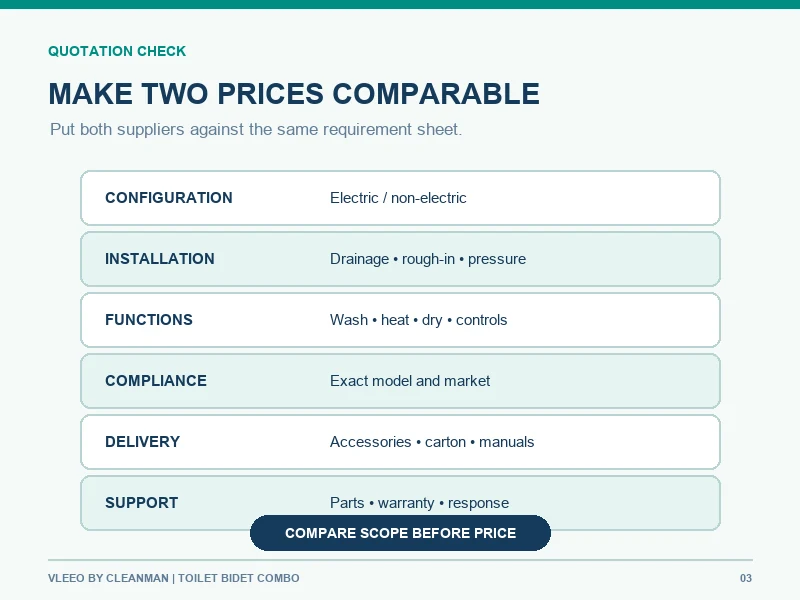
Two quotations can use the same headline and still include different products. One may include the remote holder, inlet hose, filter valve, sealing parts, backup-flush components, export packaging, and spare parts. Another may price some of them separately.
Normalize the quotations before comparing totals. Put the same fields in the same order:
- exact model and configuration code;
- electric or non-electric operation;
- voltage, frequency, and plug;
- drainage and rough-in option;
- flushing architecture and required water pressure;
- wash, heating, drying, sensor, and control functions;
- included installation accessories;
- certifications covering the ordered version;
- carton, protection, labeling, and manuals;
- spare parts, warranty, and technical support;
- Incoterm, port, quantity, and payment terms.
VLEEO’s guide to compare smart toilet quotations and configurations explains why a buyer should align the technical baseline before reading the price column.
The goal is not to choose the most expensive product. It is to know what each price includes and which customer role that configuration is meant to serve.
Build a range with clear roles
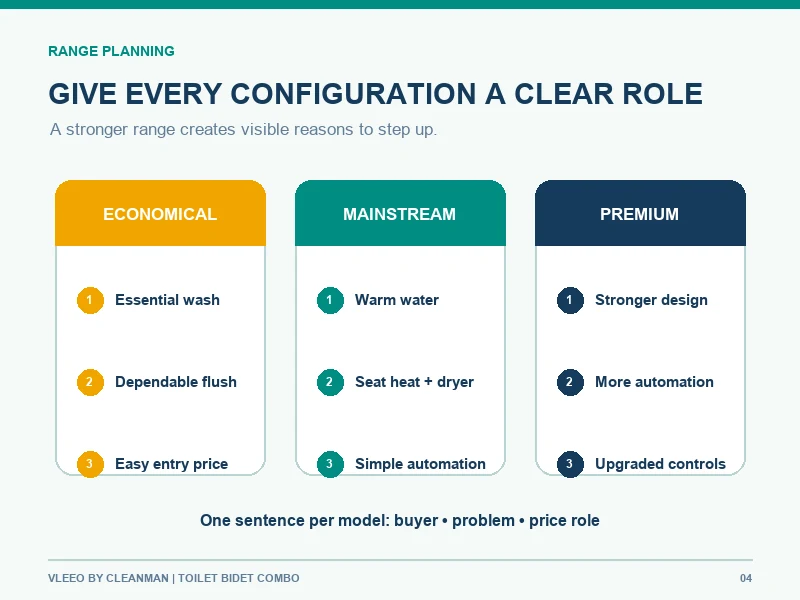
A distributor rarely needs ten models that tell the same story. A stronger range gives each configuration a job.
An economical model can focus on essential washing and dependable flushing. A mainstream electric model can add the functions most customers recognize, such as warm water, seat heat, drying, and simple automatic operation. A premium model can add stronger design, quieter or more complete automation, upgraded hygiene functions, or a better control experience where those differences are verified.
Installation options can create another layer. A model for a common floor rough-in, a wall-outlet option for a regional market, or a built-in-tank solution for less stable water conditions may solve different project problems even when the visible feature lists look similar.
The current integrated smart toilet range shows how electric, non-electric, wall-hung, built-in-tank, and different drainage options can sit within one supplier’s broader category. Use the range as a starting point, then request the exact configuration sheet for the model being considered.
Give the sales team one sentence for each product: who it is for, what problem it solves, and why it costs more or less than the next option. If the difference cannot be explained without reading twenty specification lines, the range probably has too much overlap.

Environmental and hygiene claims need restraint
Water washing can reduce a user’s reliance on toilet paper, but the exact reduction varies. Electric models also use energy, and every bidet uses water for washing. Product manufacturing, packaging, repairability, replacement parts, and service life also affect environmental impact.
Do not promise a fixed percentage of paper savings unless a reliable study covers the same use case. Do not describe a toilet as environmentally friendly only because it has a bidet function. Use verified flush-volume data, rated electrical information, replaceable-part plans, and applicable labels.
Health claims need the same care. Washing and comfort features should not be presented as treatment for a medical condition unless that claim is supported by suitable clinical and regulatory evidence. A product page or distributor article should explain washing, controls, cleaning, and accessibility without offering medical advice.
Research on toilet and bidet contamination also shows why hygiene claims should be specific rather than absolute. A review in the National Library of Medicine discusses contamination pathways and the need for more evidence; it does not prove that every bidet is unsafe or that every self-cleaning nozzle prevents infection (NCBI review).
Plain, limited claims are more credible.
What to send before requesting a quotation
A supplier can recommend a useful configuration only when the project information is clear. Send the destination country, buyer type, expected quantity, target price position, floor or wall outlet, rough-in or outlet dimensions, water-pressure information, voltage and frequency, required certifications, preferred functions, and packaging needs.
Photos and drawings help when the bathroom already exists. For a new project, send the plumbing and electrical schedule early enough to correct conflicts before installation.
Also state what you do not need. Removing an expensive function can be a sensible way to reach a price target when it does not weaken the customer’s main routine or the installation fit.
A toilet bidet combo should not be purchased as a shape plus a feature count. It should be purchased as a defined system that a customer can understand, a bathroom can support, and a distributor can service.
Frequently asked questions
1. Is a toilet bidet combo the same as a bidet seat?
No. A bidet seat replaces the seat on a compatible toilet. A toilet bidet combo combines the toilet and washing system as one complete product. The two formats differ in fit, installation, packaging, cost, and service.
2. Does every toilet bidet combo need electricity?
No. Non-electric configurations can provide room-temperature washing and mechanical operation. Electric configurations are needed for functions such as water heating, seat heating, warm-air drying, powered sensors, and electronic controls.
3. Which installation details should an importer confirm first?
Confirm the drainage type, rough-in or outlet dimensions, water-pressure range, voltage, frequency, plug type, outlet position, shutoff-valve access, and required local certifications. Use the drawing for the exact quoted configuration.
4. Does self-cleaning mean the toilet needs no maintenance?
No. Self-cleaning normally describes a specific nozzle or bowl-rinsing action. The exterior, nozzle, filter, valves, seals, and water passages still need product-appropriate care.
5. How should two toilet bidet combo quotations be compared?
Put both quotations against one requirement sheet. Compare the exact functions, flushing system, water-pressure range, electrical version, drainage option, included accessories, certificates, packaging, spare parts, warranty, Incoterm, and payment terms.
6. What makes a good first sample for a distributor?
A good sample matches the target market and demonstrates the product role clearly. It should also match local installation conditions and come with the drawing, function list, manuals, certification scope, and service information needed for evaluation.