-
Guxiang Town, Chaozhou City,Guangdong Province, China

Tankless vs. Tank-Integrated Smart Toilets: Water Pressure Guide
Introduction: Navigating Infrastructure in Modern Bathroom Projects
For B2B procurement professionals—including real estate developers, hotel group buyers, and wholesale distributors—choosing between tankless vs. tank-integrated smart toilets is a high-stakes technical decision. The core of this choice revolves around a building’s existing plumbing infrastructure. While sleek, minimalist designs are the hallmark of modern luxury, they can become a liability if the building’s water pressure cannot support the flushing mechanism.
According to the latest industry data from Arizton Advisory & Intelligence, the global smart toilet market is set to grow at a CAGR of 8.04%, reaching USD 16.09 billion by 2030. This growth is fueled by a 46% surge in demand for touchless technology and a 31% increase in AI-integrated hygiene functions globally. However, in many high-rise developments or older urban retrofits, fluctuating water pressure remains the primary barrier to successful adoption. As a specialized manufacturer with over 20 years of expertise, Vleeo provides a comprehensive smart toilet performance analysis to help buyers select the right technology for their specific site conditions.
1. Technical Comparison: Tankless vs. Tank-Integrated Smart Toilets
Understanding the mechanical differences is the first step in high-volume procurement. While both designs offer advanced bidet functions and heated seats, their flushing mechanisms are fundamentally different.
1.1 Tankless Smart Toilets: The Direct-Flush Aesthetic
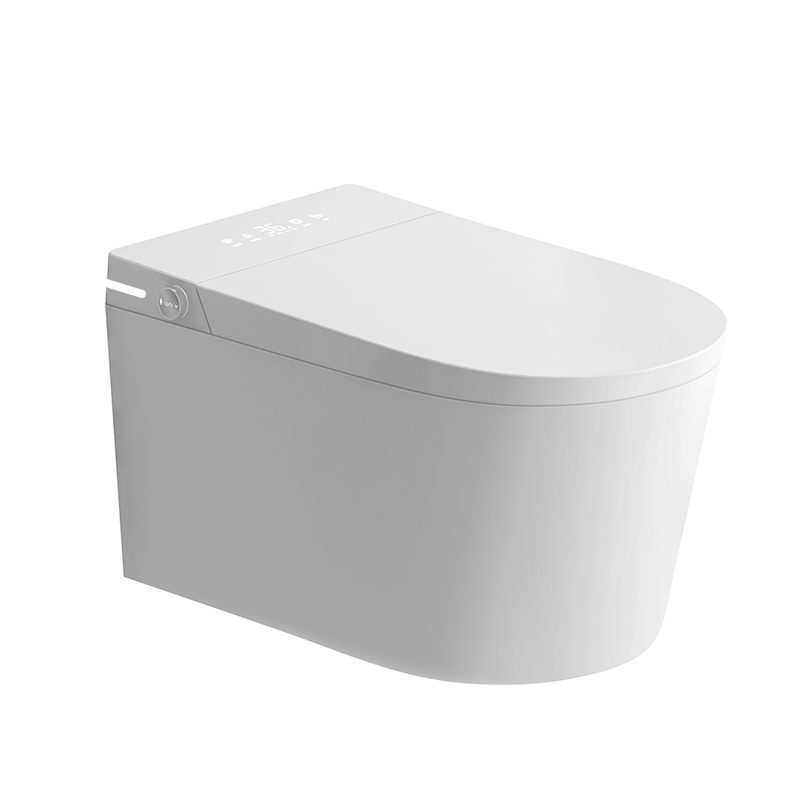
A tankless smart toilet operates without a traditional water reservoir. Instead, it connects directly to the building’s water supply and utilizes a high-pressure solenoid valve or an electric pump to create a powerful flushing action.
- Engineering Requirements: Typically requires stable water pressure between 20 and 80 PSI (0.14-0.5 MPa).
- Pros: Ultra-sleek, minimalist design; continuous flushing capability (no wait for refills); space-saving footprint ideal for compact modern renovations.
- Cons: Extremely sensitive to pressure drops. If the flow falls below 5.3 gpm, the siphonic action may fail, leading to incomplete waste removal.
1.2 Tank-Integrated (Built-in Tank) Smart Toilets: The Hybrid Solution
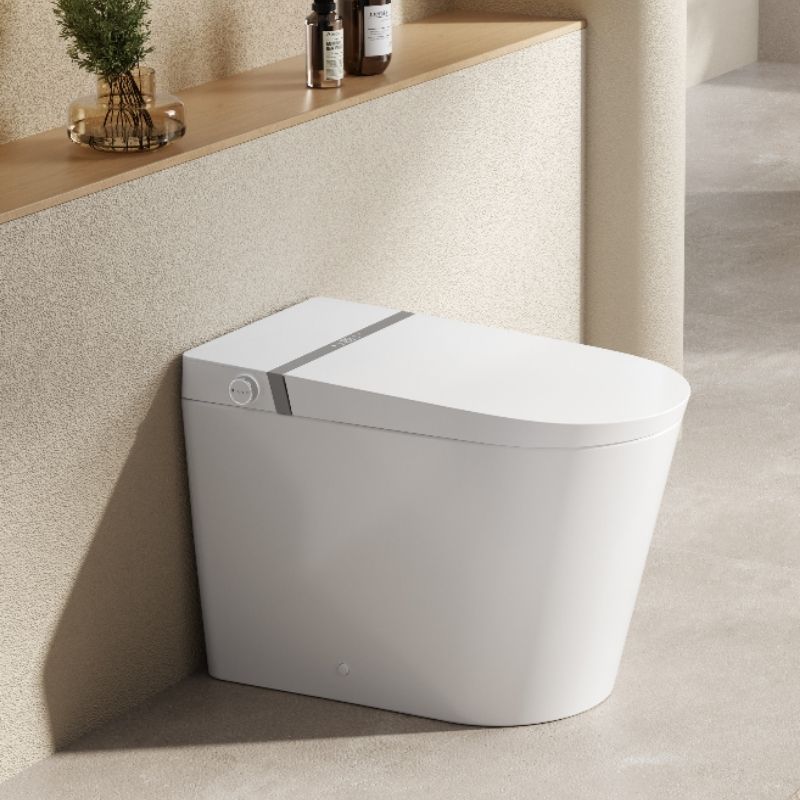
A tank-integrated smart toilet cleverly conceals a water reservoir within the ceramic body itself. This stores approximately 1.06 gallons (4 liters) of water for a consistent flush regardless of the external pipe pressure.
- Engineering Requirements: Operates effectively at pressures as low as 0.05 MPa.
- Pros: Reliable performance in low-pressure zones or high-rise buildings; quieter operation as the tank acts as a buffer; allows for a “blackout flush” using the stored water.
- Cons: Slightly larger profile than tankless units; requires more complex internal engineering, which can marginally increase initial wholesale costs.
| Performance Metric | Tankless Design | Tank-Integrated (Built-in) |
| Minimum Pressure | High (0.18 MPa / 26 PSI) | Low (0.05 MPa / 7.2 PSI) |
| Flushing Noise | High (Direct injection noise) | Low (Buffered flow) |
| Water Efficiency | 0.8 – 1.28 GPF (Highly Efficient) | 1.1 – 1.6 GPF (Standard Efficient) |
| Emergency Use | Dependent on battery/solenoid | Reservoir supports 1-2 manual flushes |
| Ideal Project | Modern high-rise (with pump) | Retrofits, Villas, Senior Living |
2. The Impact of Water Pressure on Siphonic Efficiency
In the B2B sector, the “MaP Score” (Maximum Performance) is a critical KPI for developers. A score of 1000g is often required for high-occupancy commercial projects to minimize maintenance callbacks.
For tankless vs. tank-integrated smart toilets, the MaP score of a tankless unit is “variable” based on the building’s infrastructure, whereas a tank-integrated unit provides “fixed” performance. According to(https://www.epa.gov/watersense/product-specifications) (TEXT: epa.gov) standards, high-efficiency toilets must use 1.28 GPF or less while maintaining effective waste removal. Vleeo’s built-in tank models ensure these standards are met even on the top floors of a 50-story building where pressure naturally drops during peak morning hours.
[Image 1: Comparison chart showing the water velocity of a tankless flush vs. a built-in tank flush in a low-pressure scenario (0.15 MPa).]
3. Commercial ROI: Why Developers are Choosing Integrated Tanks
Conversion in the B2B sector is driven by the bottom line. A thorough(https://vleeosmarttoilet.com/smart-toilet-functions-explained/) reveals that while tankless units have a lower initial purchase price, the “Landed Cost” of a tank-integrated unit is often lower when infrastructure upgrades are considered.
- Eliminating Booster Pumps: Installing a project-wide booster system for tankless toilets can cost a developer between USD 1,000 and USD 2,500 per unit in additional labor and hardware. A tank-integrated unit bypasses this need.
- Maintenance Savings: Tank-integrated units use a gravity-assisted vortex siphon, which reduces mechanical wear on solenoid valves compared to high-pressure direct systems.
- Guest Satisfaction: In the hospitality sector, a weak flush is the #1 guest complaint. Built-in tanks provide a “guaranteed flush” that protects the hotel’s brand reputation.
4. Advanced Logistics: EPS and Enhanced E-commerce Packaging
A smart toilet is a fragile combination of heavy ceramic and sensitive electronics. Standard packaging often fails in the “last mile” of B2B delivery.
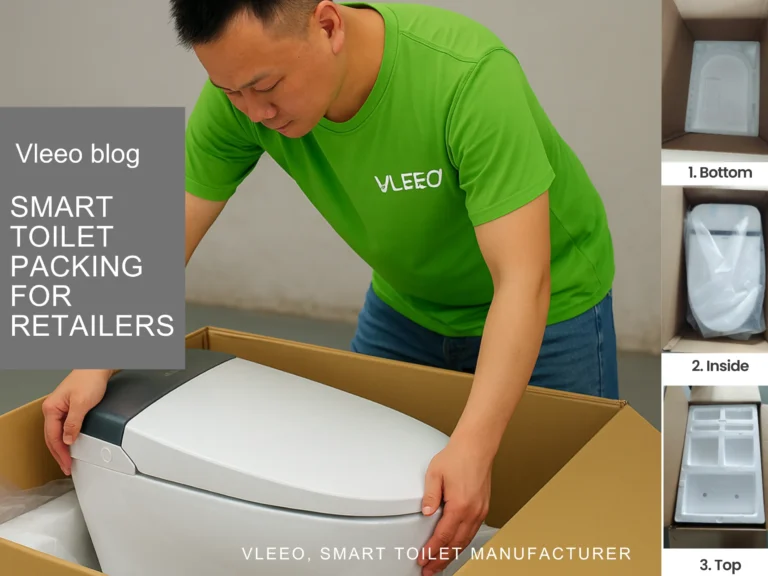
- Primary Protection (EPS): Vleeo utilizes high-density EPS (Expanded Polystyrene) foam as the foundation of our packaging. EPS provides excellent structural rigidity and cushioning, suspending the ceramic body to prevent impact damage during trans-oceanic transit.
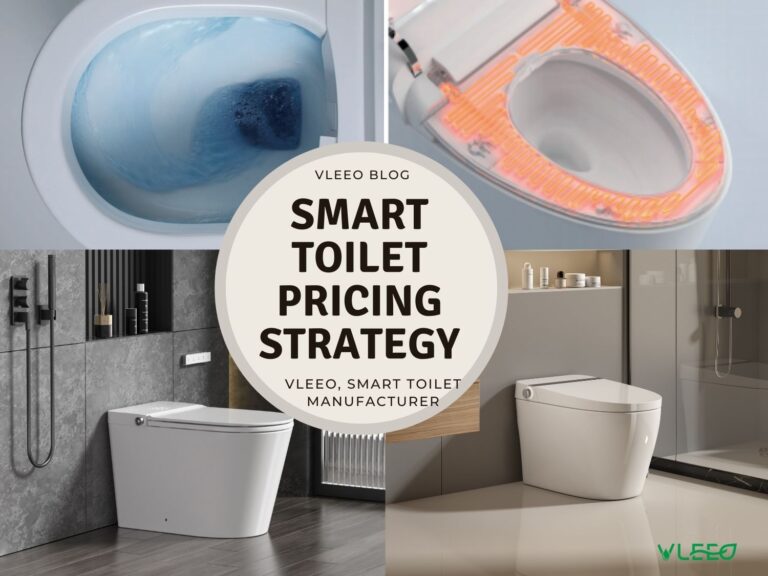
- Enhanced E-commerce Packaging: For our B2B partners involved in dropshipping or online retail, we provide an Enhanced E-commerce layer. This is a strategic reinforcement built on top of the standard high-density EPS protection. It includes thicker foam layers, reinforced outer carton edges, and internal bracing designed to pass rigorous ISTA drop tests. This ensures that even if a parcel is mishandled by a courier, the 42kg unit arrives in perfect condition.
5. FAQ: Expert Answers for Wholesale Buyers Regarding Tankless vs. Tank-Integrated Smart Toilets
Q1: Is a tankless smart toilet really more hygienic?
A: Both are hygienic, but a tankless toilet eliminates the standing water found in a reservoir. However, Vleeo solves this in our tank-integrated models by using antimicrobial ceramic coatings and a sealed internal tank system that prevents scale buildup.
Q2: Can I use a tankless toilet in a building with 15 PSI pressure?
A: We do not recommend it. For pressures below 20 PSI, a tank-integrated smart toilet from a manufacturer like Vleeo is the safer engineering choice to avoid weak flushes.
Q3: How does Vleeo handle after-sales for complex electronics?
A: As a leading Chinese smart toilet factory, Vleeo uses a modular PCB design. This means if a sensor fails, the part can be swapped in 15 minutes by a local maintenance team without needing a specialized plumber.
Q4: Do tank-integrated models require a special electrical setup?
A: No, they use the same standard GFCI (110V/220V) outlets as tankless models. The internal tank is simply a mechanical reservoir for the water supply.
Q5: Why is the 1250°C firing process important for both types?
A: High-temperature vitrification ensures a water absorption rate of <0.5%. This is the Vleeo standard that prevents the ceramic from absorbing waste odors, which is critical for long-term commercial use.
Strategic Conclusion: Partner with Vleeo’s Sales Engineers
Selecting between tankless vs. tank-integrated smart toilets is a decision that impacts the entire lifecycle of a building. At Vleeo, we don’t just sell toilets; we provide engineering solutions for global importers. Our 5 factory plants and 2.5 million set annual capacity ensure we can scale with your project needs while maintaining the highest quality standards.
Ready to optimize your procurement strategy? Contact Vleeo’s sales engineers today for a technical performance consultation and a customized quote for your bulk project.