-
Guxiang Town, Chaozhou City, Guangdong-provinsen, Kina

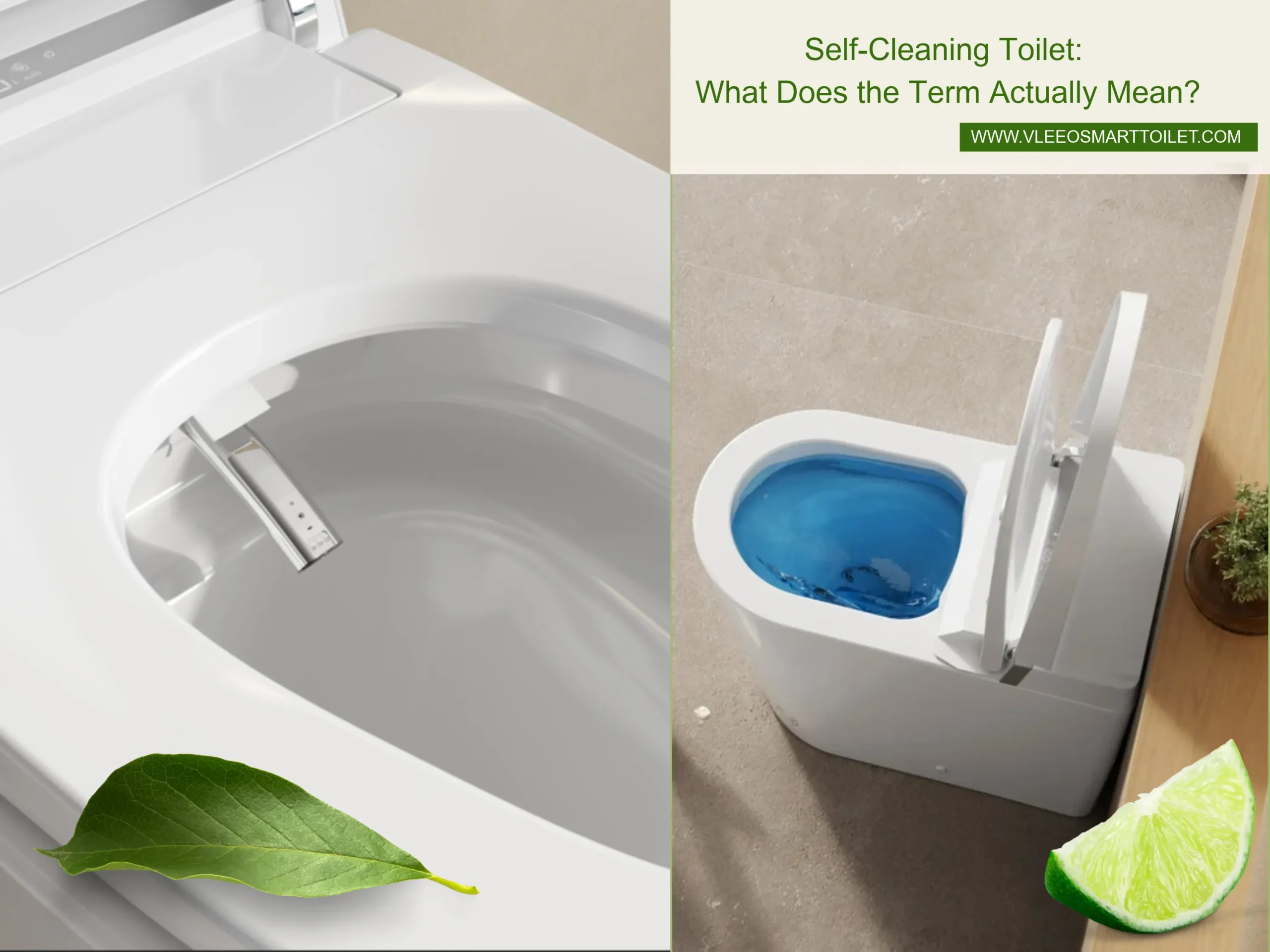
Selvrensende toilet: Hvad betyder udtrykket egentlig?
Two project contractors come to you with the same request: “We need self-cleaning toilets.” As you discuss their project requirements, a difference emerges. The first wants the bidet wash wand to rinse itself after use. The second expects the ceramic bowl to receive an automatic cleaning treatment. They have used the same term for two different jobs.
If you quote the same configuration to both contractors, one project may receive the wrong cleaning function. The mismatch then moves from the quotation to the product page, the manual, and eventually the service inbox.
The term only becomes useful when it names a cleaning target and an action. Does the toilet rinse the wand? Does it apply water or cleaning solution to the bowl? Or does it simply use features that make normal cleaning easier? That distinction should decide both the configuration you buy and the claim you publish.
For a project order, the word also sets an expectation about labor. A hotel housekeeper, a landlord’s service team, and a homeowner may each hear “self-cleaning” and imagine a different amount of work left to do. If the product only rinses the wash wand, the bowl still needs ordinary care. If it treats the bowl, the wand may still need its own rinse or manual inspection. The practical question is not whether the label sounds advanced. It is which task the installed toilet takes off someone’s list.
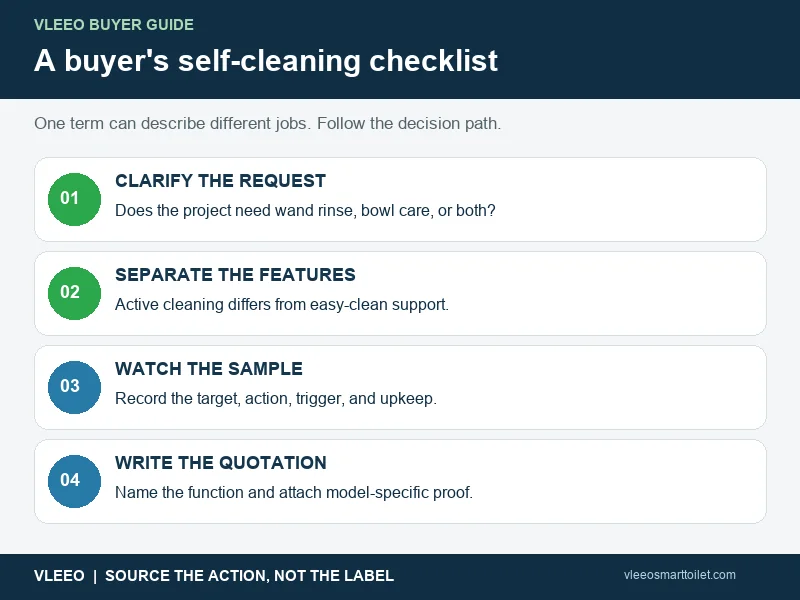
The same phrase can describe different cleaning targets
Begin with the first contractor’s request. On a model with a self-cleaning wash wand, the wand runs through an automatic rinse. Some designs rinse the outside of the wand; others also clean internal water passages. The timing can vary as well. It may happen before use, after use, or during an idle cleaning cycle.
That is a self-cleaning wand or nozzle. It is a defined function, but it does not mean the ceramic bowl cleans itself.
The second contractor is asking about the bowl. An active bowl-cleaning system applies something to the ceramic surface. Depending on the design, this may be ordinary water sprayed before use, electrolyzed water applied after use, or a measured dose of cleaning solution released with the flush. These systems act on the bowl rather than the wash wand.
The difference is easy to miss on a feature list, so it helps to separate the targets:
| Cleaning target | What the system does | Accurate wording |
|---|---|---|
| Wash wand or nozzle | Runs an automatic rinse cycle on the wand or nozzle | Self-cleaning wand; automatic nozzle rinse |
| Ceramic bowl | Applies water, treated water, or cleaning solution to the bowl | Automatic bowl-cleaning system; bowl pre-mist; cleaner-dosing system |
| Both areas | Uses separate actions for the wand and bowl | State each action separately instead of relying on one broad label |
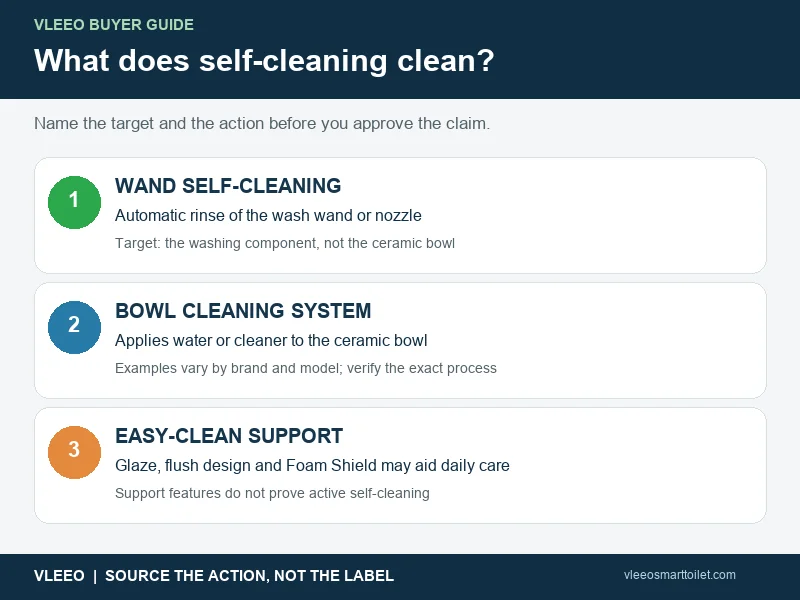
Once you divide the functions this way, you can prepare two different responses. The first contractor needs evidence of the wand rinse. The second needs evidence for the exact bowl treatment, liquid, timing, and model. A specification for one cleaning target cannot answer the other request.
Easy-clean features support cleaning but do not perform it
While preparing either response, you may also see a smooth glaze, a rimless bowl, a strong water path, or Foam Shield on the feature list. These may reduce visible residue and make routine care easier. None automatically proves that the toilet has an active self-cleaning system.
Foam Shield is a good example. The foam layer may reduce splash and help waste rinse away. It can improve the bowl experience, and it is easy to demonstrate. But the foam material must be replenished, and the ceramic still needs normal cleaning.
VLEEO’s configuration material treats the function called self-cleaning and the foam output as separate functions. That separation matters. We should not rename foam support as a self-cleaning mechanism simply because both relate to bowl care.
This gives your sales team a clearer explanation:
- A cleaning system performs a defined cleaning action on the wand or bowl.
- An easy-clean feature helps reduce sticking, residue, splash, or access problems.
- Routine maintenance still applies to both.
The wording is less dramatic, but the sample can prove it.
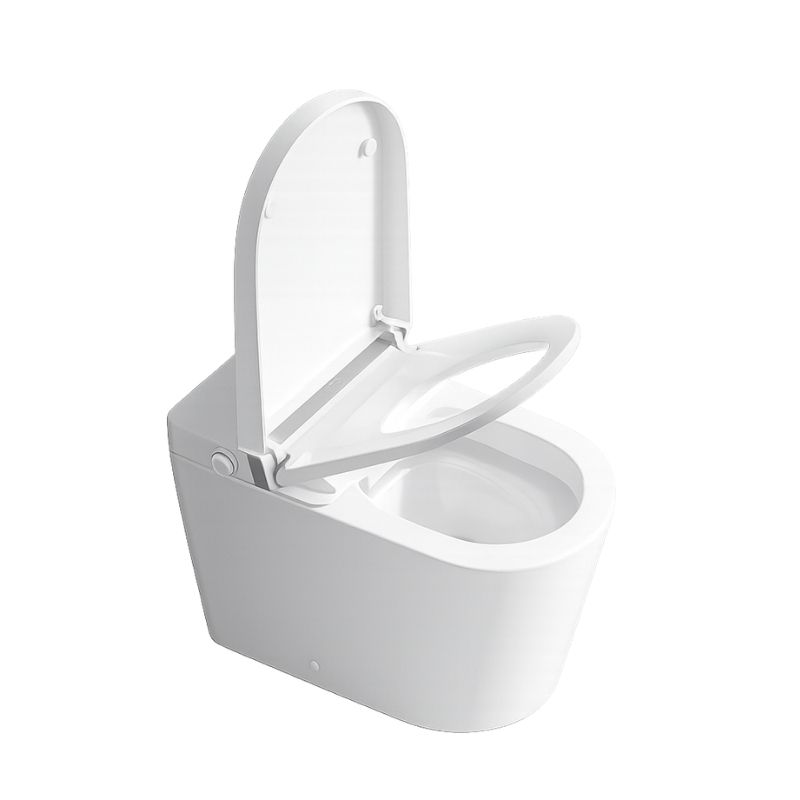
What the cleaning liquid changes after installation
The second contractor’s request becomes more specific when you ask what actually reaches the bowl. A water spray, a treated-water cycle, and a cleaner-dosing system have different supply and maintenance needs. Do not combine them under one attractive sentence in the quotation. The fluid matters because someone will have to know where it comes from and what happens when it is unavailable.
For a water-only pre-mist, the sample should show which surface gets wet and when the spray starts. A wet surface can help reduce adhesion, but that observation alone does not prove that the whole bowl is washed clean. Look at the area below the rim, the waterline, and the visible waste path. The project team can then decide whether the result matches the promise it intends to make to users.
For a system that uses a cleaning agent, ask how the agent is stored, dosed, refilled, and identified in the manual. A small reservoir can be overlooked in a showroom demonstration. Across many installed rooms, its refilling schedule becomes an operating task. If a preferred agent is hard to obtain in the target market, the feature may be less useful than it looked in the sample. The quotation should therefore describe the consumable and the person responsible for it, not just the automatic cycle.
Treated water creates another wording challenge. A brand may describe a special process that changes the water before it touches the bowl or wand. That is a claim about a defined process on a defined model. It is not permission to use words such as “sterilizes” or “kills all germs” on a different configuration. Some manufacturer manuals separate wand and bowl cleaning cycles while still calling for regular cleaning. Read the actual manual for the model you buy in the same way. Ask what is treated, when the cycle runs, and which ordinary care remains.
This distinction can change your range decision. A dealer serving individual homes may accept a refill task if the benefit is easy to explain. A hotel operator may value a simpler routine more than an additional consumable. Neither answer is universal. It depends on who maintains the rooms, how replacement material reaches them, and what the sample actually demonstrates.
The demonstration should settle the claim
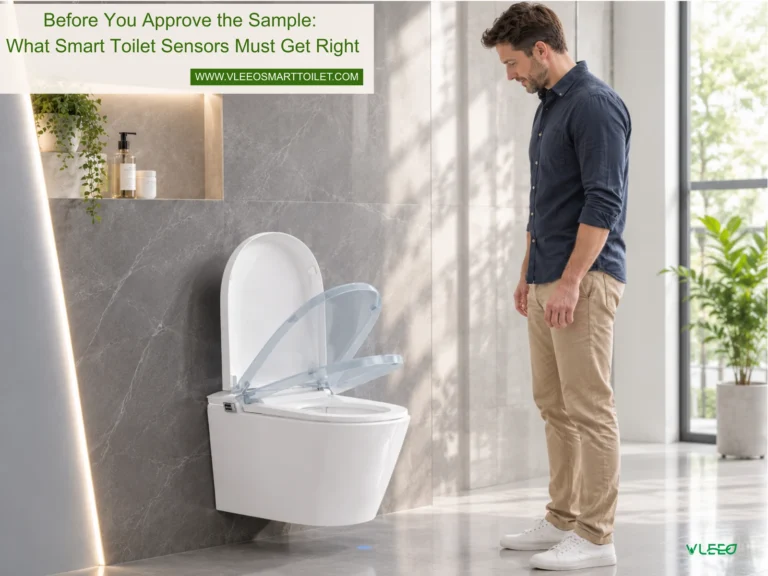
To answer the two contractors, request a sample demonstration for the proposed configuration. Watch one complete cycle before approving the cleaning claim.
For the first contractor, observe where the rinse water goes and when the wand cleaning cycle starts. Check whether the function runs automatically or needs a manual command. Then compare the remote, manual, carton, and online copy. They should all describe the same action.
For the second contractor, watch the bowl before and after use. Identify what reaches the ceramic surface, where it comes from, when the cycle runs, and whether the user must refill anything. If the system uses a special liquid, the order also needs a supply plan and clear instructions for the target market.
The cycle timing belongs in the sample review. A rinse that runs only after a wash has a different job from a bowl treatment that runs before use or after flushing. Record the trigger and the remaining hand-cleaning work, so the contractor can plan what the installed product actually requires.
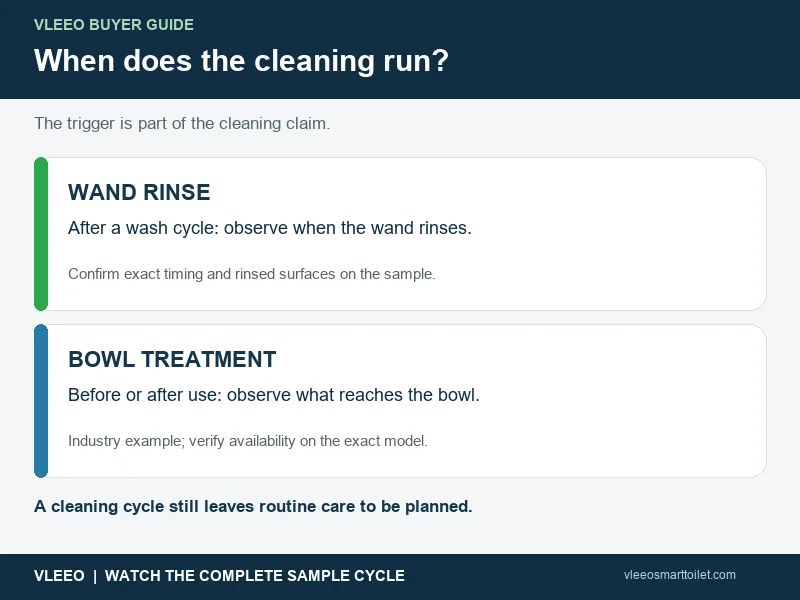
Do not turn one visible rinse into a stronger hygiene promise. “Self-rinsing” does not automatically mean antibacterial, disinfecting, sterilizing, or UV cleaning. Those claims need evidence for the exact material, process, model, and test method.
This is also separate from water efficiency and plumbing performance. For US programs, the EPA WaterSense specification for tank-type toilets uses defined water-consumption and performance requirements. A self-cleaning label does not establish those results.
The sample test that keeps a promise honest
One short product video can show that a mechanism moves. It cannot, by itself, establish every result a buyer may read into the phrase “self-cleaning.” Prepare a repeatable sample review with the exact model, voltage, water connection, and cleaning configuration on the quotation. If the displayed sample has optional functions, mark them as options. Otherwise a sales team can accidentally describe a demonstration unit as if it were every unit in the order.
Start with the idle state. Is the wand exposed, parked, or covered? Does the bowl already have water or foam on its surface? Then trigger the normal user sequence. Watch the wash, the wand return, and the rinse. Note whether cleaning occurs before use, after use, or only when someone presses a separate button. A feature that requires a manual command may still be useful, but it should not be described as an automatic action.
For a bowl treatment, watch the whole cycle from the user’s point of view and from the service team’s point of view. Does the system wet the ceramic before use, spray after flushing, or release cleaner with the flush? Which surfaces can you actually see it reach? If the treatment depends on a refill, ask how a user knows the supply is low. If the answer is not in the model’s instructions, do not invent one for the product page.
Run the demonstration more than once when possible. A single clean bowl at the start of a video tells you little about what the cycle will do after normal use. You do not need to turn the test into a laboratory claim. You need enough observation to write a precise, modest sentence: “The wand rinses automatically after washing,” for example, or “The bowl receives a pre-use water spray.” Each sentence names an action that a sample can show.
Keep a separate line in the review for what was not tested. A visible rinse does not establish antimicrobial performance. A wet bowl does not establish stain resistance over months. A quiet flush in one room does not establish a noise rating. This line protects the sales team from making an accidental leap from a real demonstration to a much stronger promise.
That is also why the maintenance manual belongs beside the video. The video answers what happens during one cycle. The manual answers what the owner or service team must do over time. Together, they give the second contractor a much clearer basis for approving a model.

One phrase on the carton can create four different promises
The sample test changes how you prepare the range. Instead of asking whether the toilet is self-cleaning, you can write down four items:
- Target: wand, nozzle, ceramic bowl, or more than one area.
- Action: rinse, pre-mist, treated-water spray, or cleaner dosing.
- User task: normal wiping, descaling, refilling, or periodic inspection. Record who will do it on the project.
- Evidence: video, manual, specification, material report, or configuration-specific test.
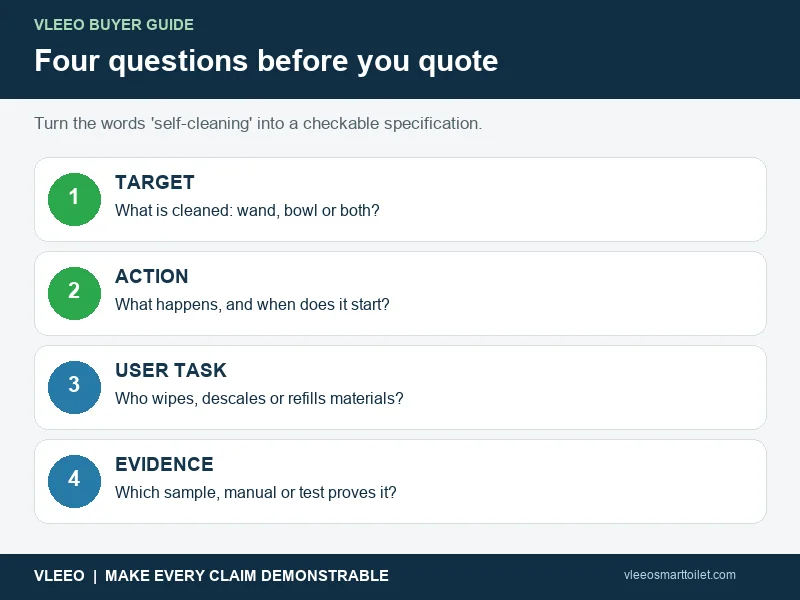
These details belong in the quotation before they reach the marketing team. If the quote only says “self-cleaning,” the product page will have to guess. If the quote says “automatic wand rinse before and after use,” the page has a claim the sample can show.
The same rule protects after-sales work. A customer who expects a fully cleaned bowl will not be satisfied by a clean wand. A hotel team that expects no consumables will not welcome an unexplained refill container. Precise wording prevents both problems before the order is placed.
Put the claim where your team can support it
Before you approve carton copy, read the product page, quick-start guide, manual, and quotation side by side. They should all refer to the same cleaning target and timing. If the quotation says “automatic bowl cleaning” but the manual describes only wand rinsing, one of the documents is making the wrong promise. Resolve that before labels are printed or listings go live.
The difference matters for customer questions. A person may ask, “Why do I still need to clean the bowl?” If the original promise was a wand rinse, the honest answer is simple: the feature cleans the wash component, while the bowl still needs routine care. If the product has a bowl treatment, the answer should explain what that treatment does and which stains, deposits, or hidden areas still need attention. The sales team should be able to give that answer without guessing.
For a hotel or apartment program, pass the same information to the people who will maintain the rooms. Tell them whether there is a refill material, where to find the instructions, and which cleaning products are permitted. An automatic cycle may reduce one repeated task, but it can also create a new supply task. The project should know both before installation, especially if units will be spread across many properties.
For a distributor, the clearest range may have more than one tier. One configuration can offer a verified wand rinse as a straightforward feature. Another may include additional bowl care if the exact model and market support it. Avoid forcing both into one feature label. When each tier has a specific promise, your team can compare prices and service needs without asking customers to decode vague marketing language.
Den VLEEO-serien af smarte toiletter is a starting point for comparing product families, not a substitute for a configuration sheet. Ask VLEEO for the current function list and sample evidence for the precise model you intend to sell. That is especially important when the same external shape is offered with different internal options.

Choose the cleaning promise before choosing the label
The two contractors may both find suitable products, but they need different answers. A verified wand-rinsing configuration addresses the first request. The second calls for a verified bowl-treatment system and a clear plan for any required maintenance or consumables.
The deciding point is not which carton uses the bigger phrase. It is which cleaning action your sales team can demonstrate, your listing can describe, and your service team can support.
For a VLEEO quotation, the safest approach is to state the cleaning result you want instead of requesting a generic self cleaning toilet. We can then check which current configuration performs that action and keep Foam Shield, nozzle rinsing, bowl-care features, and any stronger hygiene claim in their correct categories.
OFTE STILLEDE SPØRGSMÅL
1. Does a self cleaning toilet clean the whole toilet automatically?
Not necessarily. The term may refer only to an automatic wand or nozzle rinse. A bowl-cleaning system needs a separate action that applies water, treated water, or cleaning solution to the ceramic surface.
2. Is a self-cleaning wand the same as a self-cleaning bowl?
No. A self-cleaning wand rinses the bidet washing component. A self-cleaning bowl system acts on the ceramic bowl. Some products may have both, but each function should be stated separately.
3. Is Foam Shield a self-cleaning system?
Foam Shield is better described as a bowl-care support feature. It may reduce splash and help residue rinse away, but it does not replace regular bowl cleaning and requires replenishment of the foam material.
4. Does self-cleaning mean antibacterial or sterilizing?
No. Those are stronger claims. They require evidence for the exact material, cleaning process, model configuration, and test method.
5. What should be written in a smart toilet quotation?
Name the cleaning target, action, timing, remaining user task, required consumable, and supporting evidence. Avoid using only the phrase “self-cleaning.”
Send the cleaning action you expect
If you are building a smart toilet range, send VLEEO your target market, sales channel, expected quantity, voltage, flushing requirements, and the exact cleaning action you want the sample to perform. If refilling a cleaning or foam material is acceptable, include that as well.
We can review the available configurations against that requirement and prepare a sample comparison without turning an easy-clean feature into an unsupported self-cleaning claim. Kontakt VLEEO with your requirement list.