-
中國廣東省潮州市古巷鎮

非電動坐浴馬桶:在您的產品線中佔有何種定位
As a bathroom-products buyer, you may already have a full smart toilet that looks excellent in the showroom. The lid opens, the water warms, the seat heats, and the dryer finishes the routine. Customers enjoy the demonstration. But when you look at the next quotation, a harder question appears: how many people in your market will pay for the complete package?
Some customers want bidet washing but remain sensitive to the final retail price. An older apartment project may have water and drainage ready, but no suitable power outlet beside the toilet. In a warm-climate market, the heated seat and warm-water wash that impress one customer may do little to close another sale. You can offer a conventional toilet, but then the customer loses the integrated rear and front wash that first attracted them.
So the real buying question is not, “How can I sell a cheaper full smart toilet?” It is, “Can I offer an integrated toilet with rear and front washing that does not need electricity?” That change in the question leads you to a different product route, not just a shorter feature list.
A non electric bidet toilet answers that question. It keeps personal washing and flushing in one complete fixture, while leaving out the powered comfort functions that raise the price and require an outlet. For you, this is not a reduced version waiting at the bottom of the catalog. It can fill the space between a conventional toilet and a full-electric smart model, giving your range one more customer it can serve.

The Missing Power Cord Changes the Product Promise
A non-electric bidet toilet uses incoming water pressure and mechanical controls for personal washing. The water is normally supplied at room temperature. Because there is no electric heater, it cannot provide instant warm water, a heated seat, warm-air drying, powered deodorization, or app control.
That shorter function list is also a clearer promise. Your customer gets an integrated toilet and bidet wash without planning an electrical outlet beside the toilet. This can be useful in an existing bathroom where adding protected power would increase renovation work, or in a range where the buyer wants a simpler step above a conventional toilet.
The right sales language matters. Do not present room-temperature washing as if it were heated. Do not call a manual control automatic. Instead, explain the real exchange: the customer gives up powered comfort functions and keeps integrated personal washing without an electrical connection.
Washing and Flushing Are Two Different Systems
The word “non-electric” describes the power requirement, not one universal flushing design. Personal washing and bowl flushing should be checked separately.
The bidet wash normally relies on water pressure. Turning a mechanical control sends water to the wand for front or rear washing. The user may be able to adjust the flow, but the exact control and spray options depend on the selected configuration.
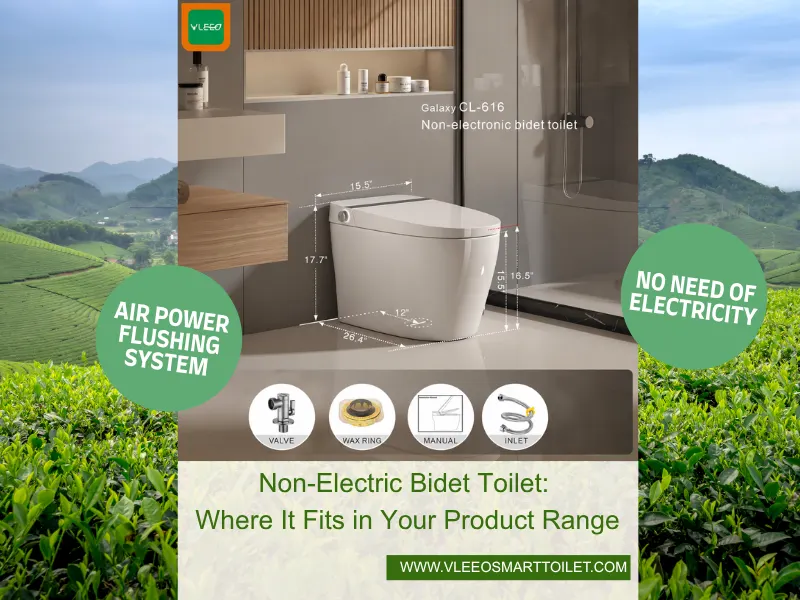
Flushing can use a different internal route. One verified VLEEO CL-616 non-electric configuration combines room-temperature front and rear washing with an air-powered flush system. It also includes a side button and foot-kick flushing, while the specification identifies internal water-control components and a concealed water tank. This is not the same as a traditional exposed gravity tank, and it should not be described as an external commercial flushometer.
That example shows why you should not infer the whole product from one label. Ask how the wash is controlled, how the bowl is flushed, what incoming water pressure is required, and what happens if the supply pressure is near the lower end of the stated range.

A Non-Electric Model Needs Its Own Place in the Range
Place a non-electric model beside a full-electric smart toilet and a conventional toilet. The three products should not compete only on feature count. Each one should answer a different buying question.
| Product Route | What the Customer Gets | Best-Fit Buying Situation | What Must Be Clear |
|---|---|---|---|
| Conventional toilet | Familiar flushing and seating | Basic replacement or lowest entry price | Flush type, rough-in, water use, seat and installation parts |
| 非電動坐廁 | Integrated room-temperature wash without power | Renovation, no suitable outlet, simpler bidet range, economical upgrade | Water pressure, wash controls, flush architecture, drainage and included parts |
| Full-electric smart toilet | Heated washing and powered comfort functions according to configuration | Mainstream or premium smart range | Voltage, outlet, rated power, sensors, controls, backup operation and service parts |
This positioning helps your sales team avoid two weak explanations. The non-electric model is not “almost the same” as the electric model, because the daily experience is different. It is also not just a conventional toilet, because the personal wash system is built into the product.
Your sample selection should make that difference visible. Let the buyer operate the mechanical wash control, check the spray, use the flush controls, and compare the installation requirements with an electric unit. A clear five-minute demonstration is more useful than adding vague “smart” language to the carton.
Room-Temperature Washing Can Be the Right Promise
Warm water is valuable when the market expects it, especially in colder climates or higher price tiers. It is not automatically necessary in every channel. Some buyers care more about having an integrated wash than about heating the water, while some projects cannot easily add power at each toilet location.
This makes climate, customer expectations, and showroom education important. In a market where bidet washing is already familiar, a mechanical wash control may be easy to explain. In a market where buyers associate every smart toilet with a heated seat and dryer, the non-electric product needs a precise name and a live demonstration so customers do not buy with the wrong expectation.
Your quotation and online copy should use the same boundary. “Non-electric bidet toilet,” “room-temperature front and rear wash,” and “mechanical wash control” are clearer than a broad claim such as “all smart functions.” If a function belongs only to one configuration, keep it out of the category-wide promise.

Installation Can Decide the Sale Before Features Do
The absence of a power requirement removes one installation question, but it does not make every bathroom compatible. You still need the exact drainage drawing, rough-in, product dimensions, shutoff position, inlet connection, and required water-pressure range.
Start with drainage. Confirm whether the order uses an S-trap floor outlet or a P-trap wall outlet, and check the dimension against the finished wall. Do not approve a model from a photo when the building drawing requires a different outlet direction or rough-in.
Then check water conditions. Both washing and flushing may depend on the incoming supply, although they can use different valves or internal structures. Ask for the stated working-pressure range and test a sample under conditions close to the destination project. “Works without electricity” does not mean “works at any water pressure.”
Finally, plan service access. The installer needs practical access to the shutoff valve, filter, hose, and control parts. A skirted body may hide connections neatly, but it should not turn a small service task into removal of the whole fixture. Review the installation drawing and manual for the exact version before your team approves packaging, showroom placement, or a project quotation.
Keep the Approved Configuration Consistent
Integrated toilet platforms may be offered in more than one configuration. The same general ceramic design or model family can appear with electric and non-electric function packages. That makes configuration control part of the buying job.
Your sample, quotation, specification, carton artwork, manual, and order should all describe the same product. If the sample has a foot-kick flush but the manual shows only a side button, the sales team and installer will not know which promise is correct. If an electric product page is reused for a non-electric version, customers may expect heating, drying, or remote control that the ordered unit does not have.
Use a configuration code or a written function table, not only a model name. Record the wash modes, water temperature, flush controls, drainage option, required water pressure, included accessories, and packaging language. This protects the buyer and the supplier when a platform has several market versions.

Compare the Cost You Can Support, Not Only the Unit Price
A non-electric configuration removes powered heaters, fans, sensors, displays, and electronic controls from the product promise. That can reduce the number of electric functions your team must explain and support, but it does not make the product maintenance-free.
The wand, valves, filter, hoses, seals, seat hardware, and flushing components still need correct installation and care. Hard water can affect spray openings and water-control parts. The correct cleaning method and replacement parts must come from the selected model’s manual and service information.
Before you compare quotations, normalize what is included. Check the exact wash and flush configuration, connector set, inlet hose, filter or valve, fixing parts, seat, manual, carton protection, spare parts, warranty terms, Incoterm, and certification scope. A lower price may represent a different package rather than a better purchase.
For buyers building a broader bathroom offer, VLEEO’s parent company also supplies conventional toilets and basins through Cleanman. This can help you compare where a non-electric bidet toilet belongs between a basic ceramic range and a full-electric smart range.
Build the Sample Brief Around the Real Market
Before requesting a sample, send the supplier a short market brief. Include the destination country, sales channel, target price position, expected quantity, drainage type, rough-in, available water pressure, required certifications, preferred wash controls, and packaging language.
Also state what the product does not need. If the market does not require heated water or a dryer, there is no reason to let those missing functions make the non-electric model sound incomplete. The product should be judged against the job you selected for it.
VLEEO offers non-electric and full-electric routes within its integrated toilet range. You can review the broader VLEEO 智慧馬桶系列 and then request the exact drawing and function sheet for the configuration you want to test. A sample should confirm the promise before an order: the wash, flush, installation, controls, and support package must all match the intended market.
常見問題
1. Does a non-electric bidet toilet need a power outlet?
No. Its personal washing and basic operation do not depend on an electrical outlet. You still need to confirm the water-supply, pressure, drainage, and installation requirements for the selected model.
2. Does a non-electric bidet toilet provide warm water?
Normally, no. It usually supplies room-temperature water from the connected water line. If warm water is required, choose an electric configuration or another system specifically designed and approved for that function.
3. Is every non-electric bidet toilet flushed in the same way?
No. “Non-electric” does not define one flushing architecture. A product may use gravity, pressure-related, air-powered, or another model-specific internal arrangement. Confirm the flushing design and required water pressure in the exact specification.
4. Is a non-electric bidet toilet the same as a bidet seat?
No. A bidet seat replaces the seat on a compatible toilet bowl. An integrated non-electric bidet toilet combines the ceramic toilet and personal wash system as one complete fixture.
5. Who is this product route best suited to?
It can fit renovation bathrooms without a suitable outlet, economical integrated-bidet ranges, and buyers who want room-temperature personal washing without powered comfort functions. Final suitability depends on local expectations, plumbing conditions, and the selected configuration.
6. What should you confirm before requesting a quotation?
Confirm the destination market, drainage type, rough-in, water-pressure range, wash controls, flush system, included installation parts, certification requirements, packaging, spare parts, warranty, quantity, and Incoterm.
Discuss Your Non-Electric Bidet Toilet Range With VLEEO
If you are deciding where a non-electric bidet toilet fits in your range, send VLEEO the market, channel, drainage layout, water-pressure conditions, target price position, and the functions your customer actually expects. We can help you compare a non-electric configuration with a full-electric model before you approve a sample or quotation.