-
Guxiang Town, Chaozhou City, Guangdong Province, China

Tankless Smart Toilet for Low-Pressure Projects: What a Sample Must Prove
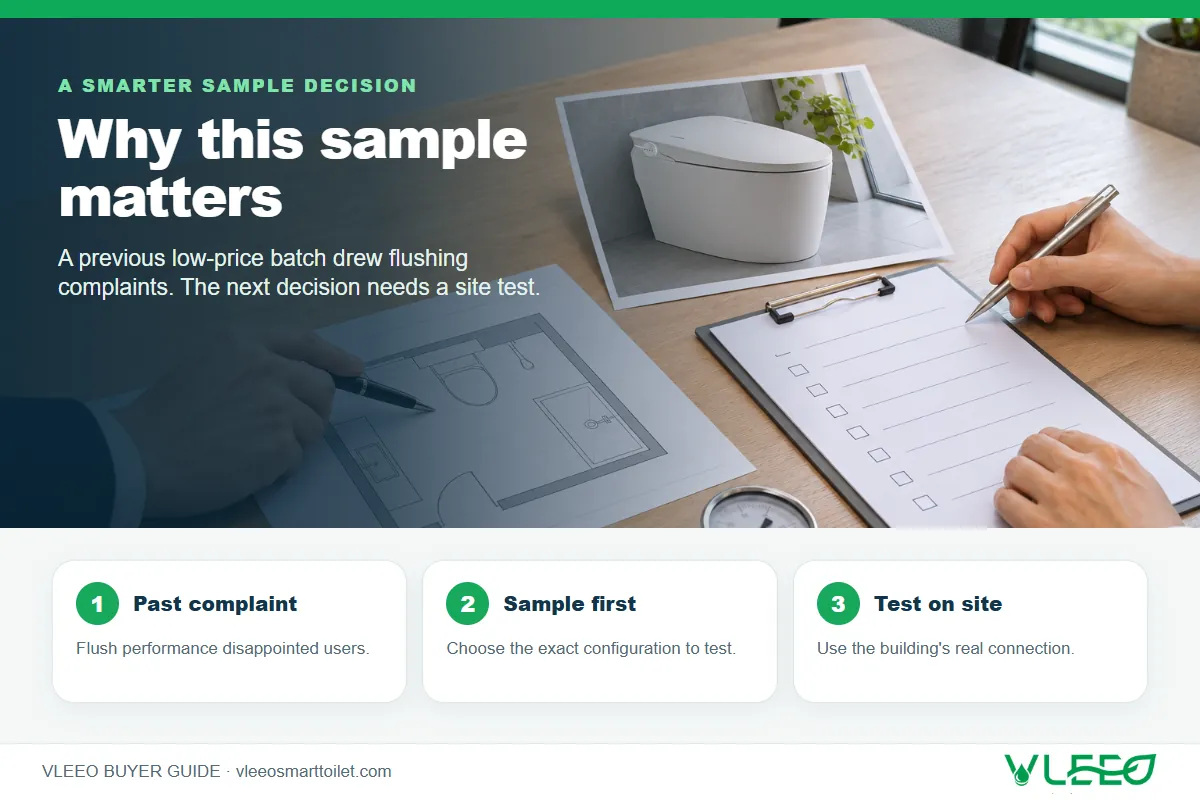
A customer came to us looking for a smart tankless toilet for a low-pressure project, with an unusual request: his client wanted to buy a sample smart toilet and test it at the building’s water pressure before discussing a larger order. Once we asked why, the concern made sense. The project owner had previously chosen a lower-priced batch of smart toilets and then received repeated complaints that the toilets did not flush properly. A new feature list would not solve that problem. The next sample had to show, in the actual project setting, that the flush could work.
If you source a smart tankless toilet in a hotel, apartment building or distribution range, you may face the same question. The smooth one-piece shape is easy to compare in a catalogue. The flushing system behind that shape is not. A model with no visible rear tank may still have an internal water reservoir, while another model with a similar appearance may depend more directly on water arriving from the supply pipe at the moment of flushing.
That difference is what the customer needed to understand before spending money on another batch. It also gives you a better way to discuss a tankless smart toilet with a project owner: start with how the exact model will flush in the rooms where it is going to be installed.
The Buyer Was Testing a Complaint, Not a Feature
The sample request was not a sign that the customer doubted every smart toilet. The owner had a specific memory of what had gone wrong before: end users complained about flushing. If the new sample worked only in a supplier’s showroom, the owner would still have no answer for the building.
That is why we did not lead the conversation with a longer list of seat, wash or sensor functions. We asked about the project’s water supply and discussed an internal-tank full-electric configuration with a stated working inlet-pressure range of 0.08–0.8 MPa. The number is useful only when it belongs to the exact version being quoted. It is not a rating to copy onto every VLEEO smart toilet, and it does not replace a sample test at the project site.
The buyer’s next decision was therefore practical: which model and configuration should be sampled, where should it be connected, and what test result would allow the project owner to approve the order? Until those three points are clear, the phrase “low-pressure smart toilet” remains a claim rather than a project decision.
What “Tankless” Tells You—and What It Does Not
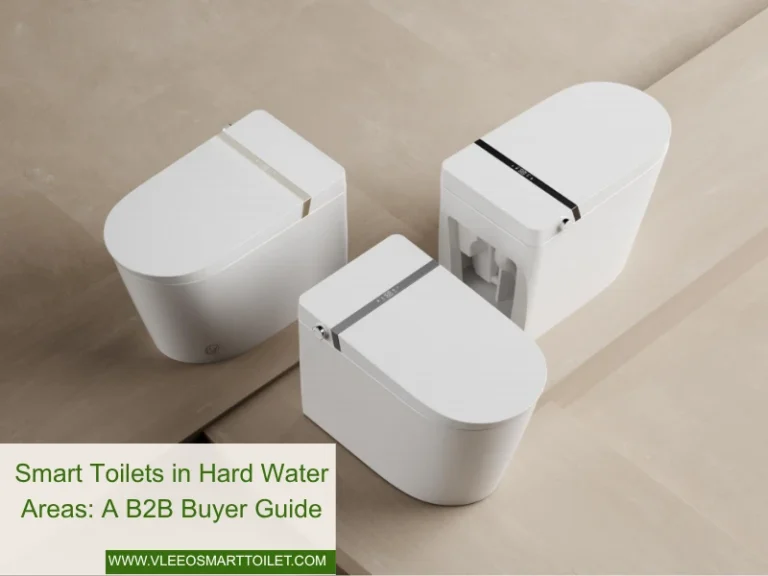
In the smart toilet market, tankless often describes the appearance of the toilet. There is no separate ceramic water tank behind the seat. That compact body can suit a modern bathroom, but the outside does not reveal the whole flushing system.
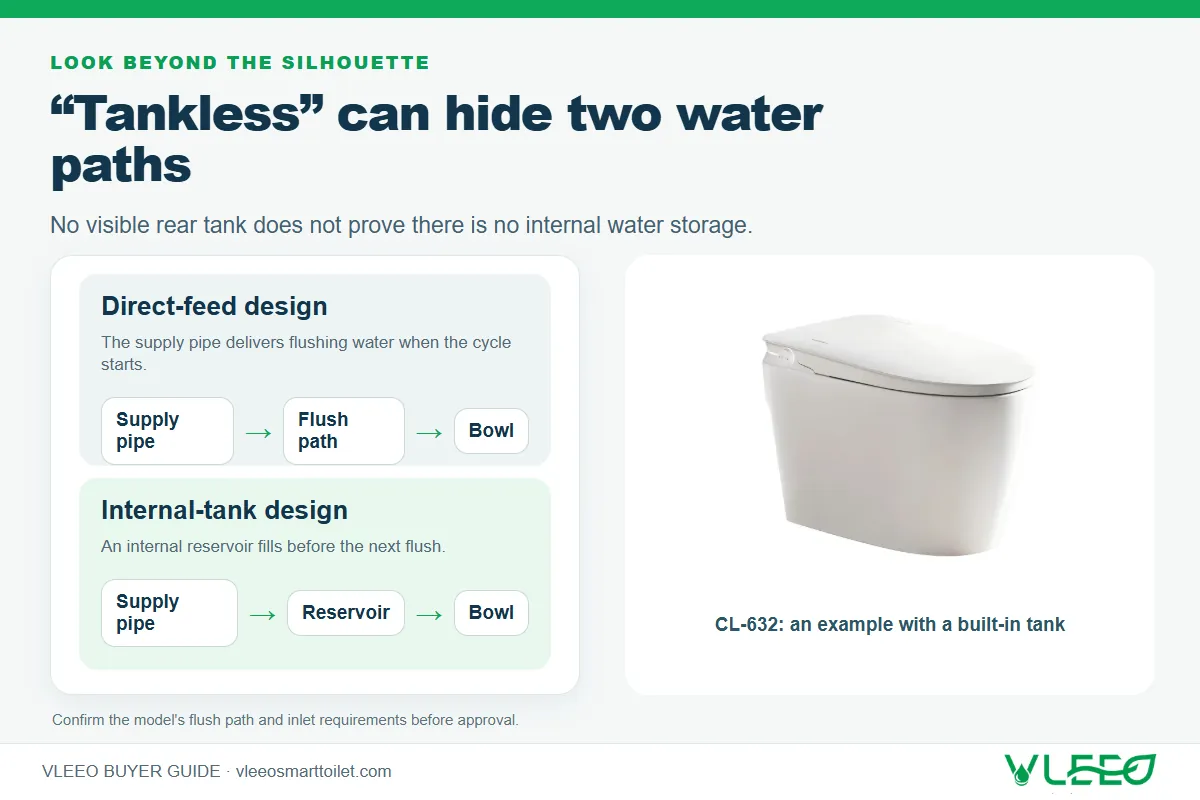
Some compact toilets draw flushing water directly from the building supply. Some VLEEO models have no separate external tank yet contain a concealed flushing reservoir inside the toilet body. An internal tank can store water ahead of the next flush, and a model may also use a booster system to send the water into the bowl. Both designs can have a smooth, tankless-looking outline. Their inlet requirements and behavior during repeated use can differ.
This is not wordplay. Kohler’s explanation of how a toilet flushes describes tanks made integral to a bowl as well as commercial designs that use only the supply line. The same distinction matters when you read a smart toilet offer. A photo can show that the external tank is gone; it cannot tell you whether there is stored flushing water inside.
Be precise in the quotation. “Tankless smart toilet” can name the compact product type. “Smart toilet with built-in tank” can identify one possible internal flushing structure. Neither phrase on its own proves the model’s working pressure, flow requirement, refill time or power-off behavior.
How an Internal Tank Helps a Tankless Smart Toilet at Lower Inlet Pressure
In a direct-feed design, the pipe must supply the water needed for flushing at the required rate while the flush is taking place. If the supply falls below the model’s requirement during busy periods, the result may be weak, incomplete or inconsistent. The right threshold depends on the model, not a generic category label.
An internal-tank design changes the timing. Incoming water fills a reservoir before the next use. When the toilet is activated, stored water is delivered through the selected model’s flush path. In a booster-assisted version, the pump helps move that stored water. This arrangement can reduce dependence on a high instantaneous flow from the building pipe. It does not create water from nothing, and an internal tank alone does not generate incoming water pressure.
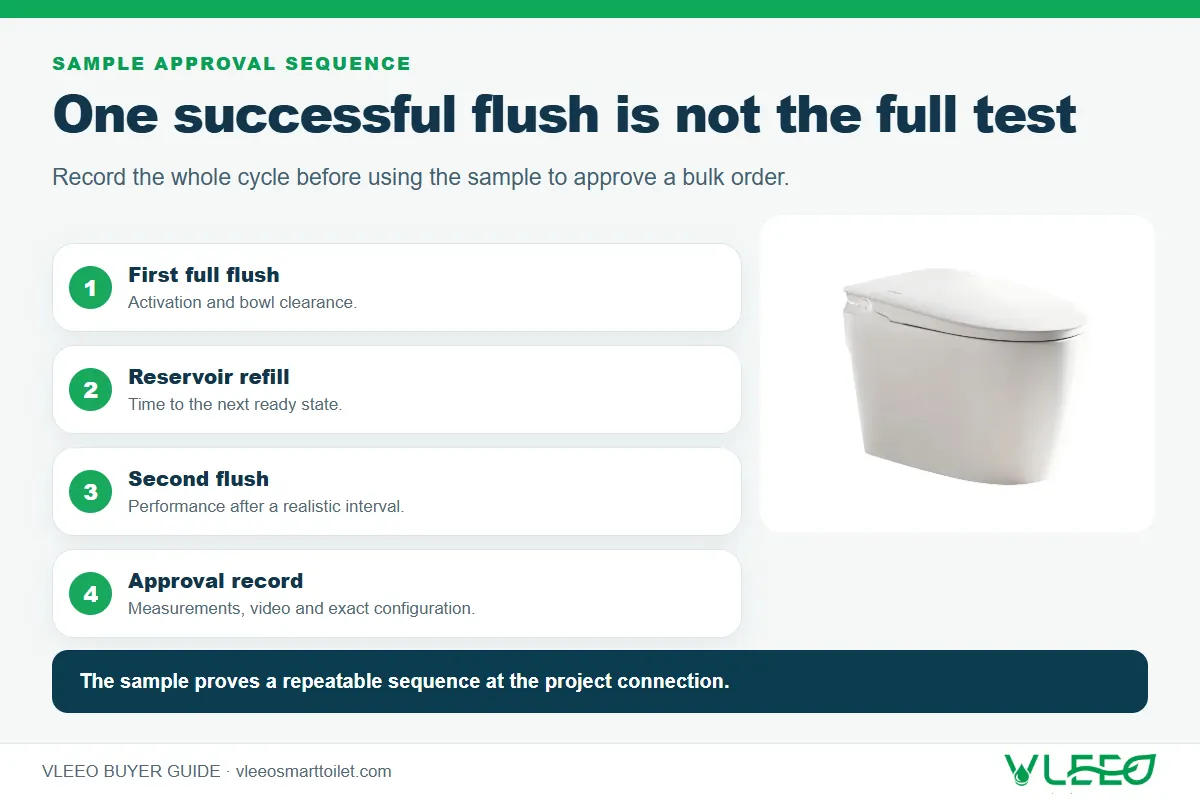
The reservoir must refill after use. If the building supply is below the specified inlet range, is interrupted, or cannot provide enough flow over time, an internal tank is not a magic fix. A sample must show the first flush, the refill and a second flush under conditions that resemble the rooms in the order. This matters especially where many units will be installed or a shared bathroom will be used repeatedly.
The case also raises a terminology trap: the small water system used for warm bidet washing is not necessarily the tank that supplies the toilet flush. Ask which reservoir a supplier means. A claim about heated wash water tells you little about how the bowl clears waste.
Test a Tankless Smart Toilet for Low Water Pressure at the Project Connection
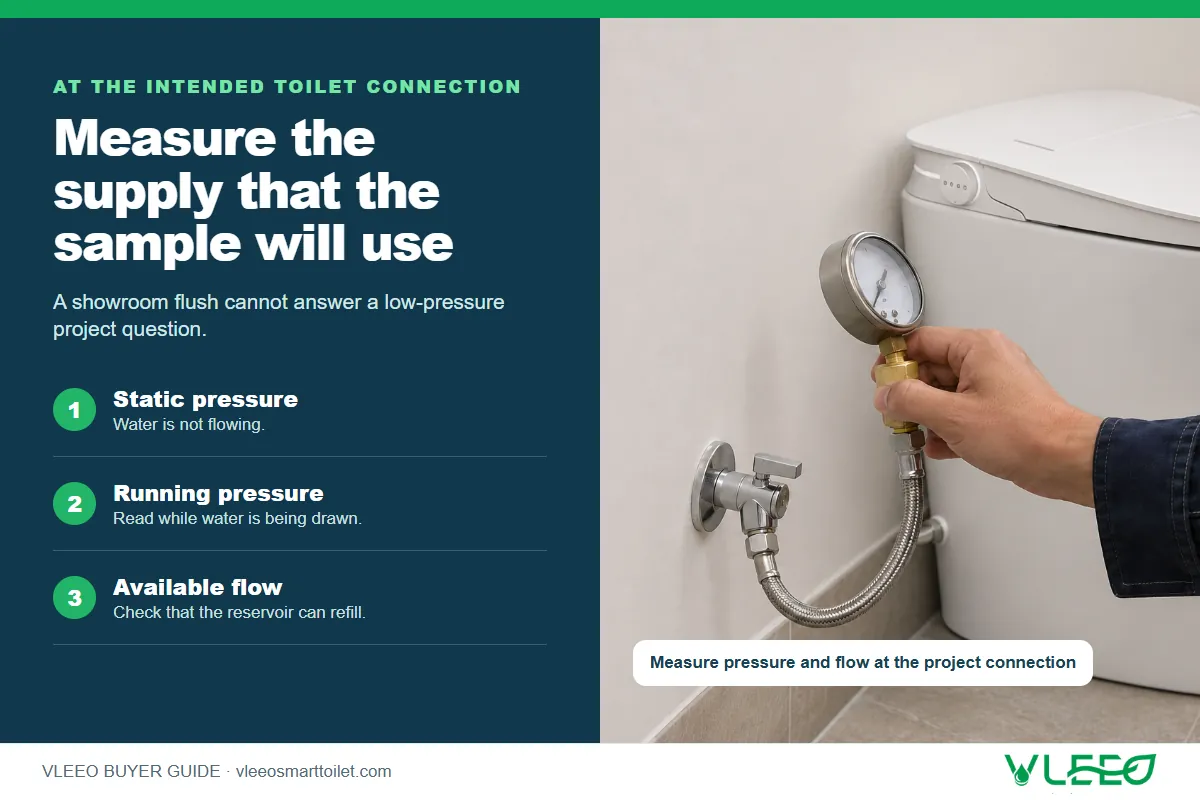
For the customer’s project, a sample would be meaningful only if it answered the owner’s earlier complaint. A clean flush at a well-supplied showroom does not prove what will happen at the building. Ask the project team to identify the intended toilet connection and take readings there, ideally under the low-supply conditions the owner is worried about.
Record both static pressure, when the outlet is not flowing, and running pressure while water is being drawn. The available flow matters too. A higher reading near a pump room or at a different time of day may not describe an upper-floor bathroom during peak use. Kohler’s fixture-pressure guidance likewise emphasizes that specific products may need their own pressure and flow conditions on the specification sheet. Its pressure figures belong to Kohler products; they are not VLEEO ratings.
The 0.08–0.8 MPa range discussed with our customer is approximately 0.8–8 bar, or 11.6–116 psi. Give your installer the units and the exact model sheet. Do not tell a project owner that the toilet will work at a measured “0.08” without confirming the unit, the measurement point and whether that reading stays within the model’s requirement during use.
If the project has several room types or floors, one convenient test point may not be enough. The project team should choose locations that represent its real low-supply condition. This is an engineering decision for the site team; the supplier’s job is to provide a sample and a clear product boundary for them to test.
Agree on What a Passing Sample Looks Like
Before the sample arrives, turn the owner’s concern into an observable sequence. Otherwise one person may call the test successful because the automatic flush activated, while another person is still worried that the bowl did not clear.
| Test item | What the team should record | Pourquoi est-ce important ? |
|---|---|---|
| Sample identity | Model, configuration, voltage and key flushing components | The bulk order must match what was tested. |
| Site supply | Connection point, static and running pressure, available flow and test time | A showroom result cannot substitute for the project condition. |
| First full flush | Activation, bowl clearance, water movement and any error or incomplete cycle | This directly addresses the past complaint. |
| Refill and next flush | Time to ready state and performance after a realistic interval | An internal reservoir still needs to refill. |
| Power-off operation | Whether a separate manual or backup flush works, if required | Stored water does not automatically mean power-off flushing. |
| Approval record | Video, measurements, sample sign-off and any changes | The accepted sample becomes a useful purchase-order reference. |
Use the intended power supply and plumbing arrangement during the test. A temporary hose, a different voltage or an extra booster pump can make a sample pass for the wrong reason. If the project changes the plumbing after testing, note the change and decide whether another test is needed.
Do not claim that the customer’s project has passed this test; at this stage, the case tells us why the owner asked for a sample, not its final result. The approval should be based on the recorded outcome, not confidence alone.
If the Sample Fails, Find the Cause Before Rejecting the Category
A failed sample does not immediately prove that every tankless smart toilet is unsuitable. It tells the team that this configuration, at this connection and under this test condition, has not met the project’s requirement. That distinction can save a buyer from making the same broad assumption in the opposite direction.
Start with the measured supply at the toilet. Was the inlet pressure below the selected model’s stated minimum while water was flowing? Did the supply line deliver enough volume to refill the internal reservoir? Check that the stop valve is fully open and the specified inlet pipe and filter are fitted correctly. Then confirm that the sample has the intended voltage and that the flush system completed its normal sequence. The installer and supplier should record the observation before changing any part or setting.
If the first flush works but the next one does not, the refill interval may be the issue. If neither flush completes, the supply, installation or model configuration may need review. If the toilet operates in one room but not another, the site team should compare those connections before blaming the ceramic shape. These are starting points for investigation, not a diagnosis that can be made from a video alone.
For the project owner in our customer’s case, this record would make the sample decision useful even if the first test failed. The team could adjust the proposed configuration, correct an installation issue or decide that the building supply needs attention. What matters is that the next order would be based on a measured cause rather than another price-led guess.
The Lowest Price Is Not the Same as the Lowest Project Cost
The earlier order was chosen partly on price, but the later complaints changed what the project owner valued. The price of a smart toilet is visible on the quotation. The cost of repeated calls from occupants, uncertain repairs and a second procurement round is harder to see before installation.
That does not mean every project needs the most expensive model. It means the comparison must include the flushing structure and the site test. If a simpler direct-feed configuration meets the building’s measured conditions and target price, it may be a sound choice. If a project has a lower or less stable supply, an internal-tank option may be worth testing even if its first price is higher. The sample decides more than the sales label.
For a distributor, this also changes how the range is presented. A low-price model and an internal-tank model need different application notes. The catalogue should make it easy to see which version was tested, which pressure range belongs to it and what installation conditions the customer must check. Otherwise, the same complaint may follow the distributor into another project.
Match the Quotation to the Approved Sample
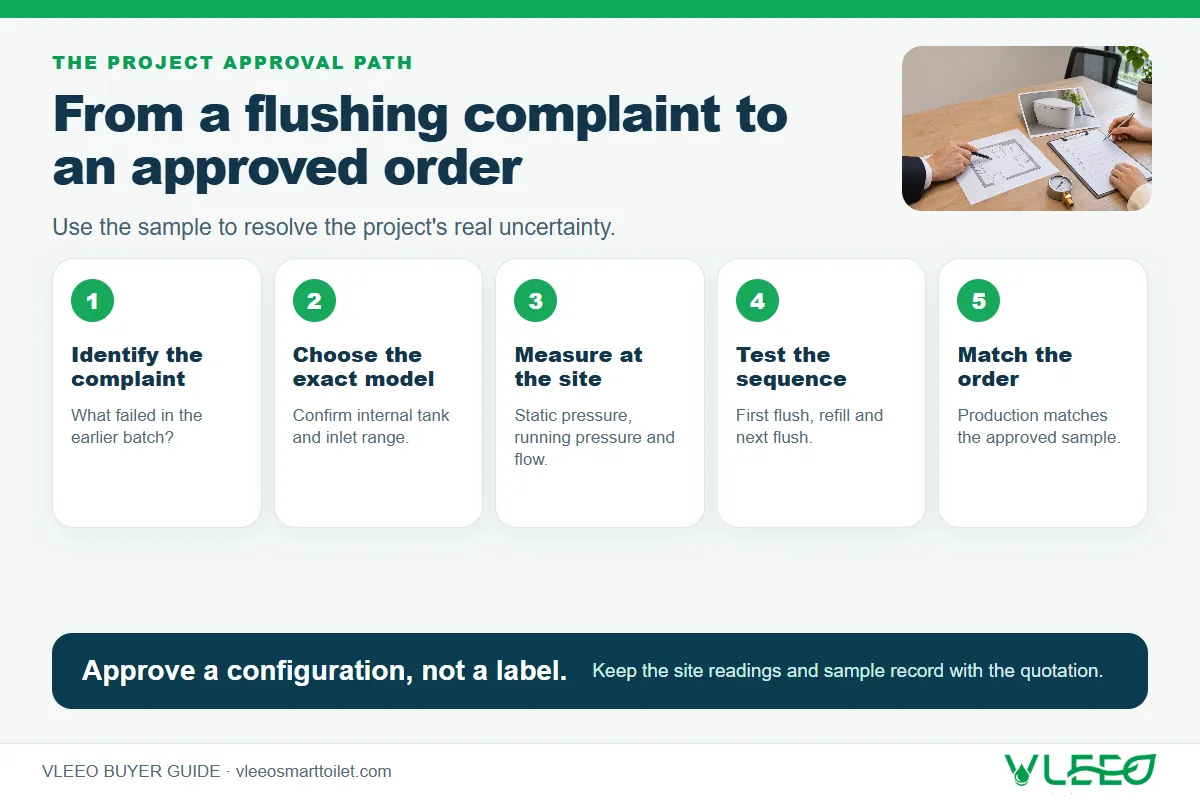
When the owner approves a sample, preserve the exact basis of that approval. A purchase order should state the model and configuration, the flushing-system version, voltage, supply and drainage connection, rough-in, included controls, and required documents. If a pump, valve, controller or tank arrangement changes between the sample and production, the buyer needs to know before the order is released.
VLEEO’s Toilettes intelligentes CL-632 avec réservoir intégré is a concrete example of a compact full-electric model with concealed water storage and booster-assisted flushing. It demonstrates why “tankless” appearance and an internal tank can coexist. The CL-632 page is not, by itself, evidence that every VLEEO model shares the same pressure range or that this model fits the customer’s project without a site test.
If the customer also needs bidet washing, heated seating, warm-air drying or touchless operation, include the exact functions in the same configuration schedule. They matter to the sale, but they should not distract from the flush concern that started this inquiry.
What to Say When a Customer Asks for a “Tankless” Toilet
Start with the room and the supply condition rather than correcting the customer’s terminology. If the customer wants a clean shape with no visible rear tank, show the compact models that fit that look. Then ask whether the project has measured water pressure at the installation points and whether flushing complaints, power outages or repeated-use demand are part of the brief.
Once you know that, explain the internal structure in one sentence: the chosen model either takes flushing water directly from the building supply or stores it inside the toilet before the flush. If it has a built-in tank and booster-assisted design, describe how that helps the selected configuration work within its rated inlet range. Do not promise that the tank alone will solve every pressure problem.
This conversation is more useful than a generic claim that all tankless toilets are either pressure-hungry or pressure-proof. It lets the customer choose a sample for a reason they can test.
Questions fréquemment posées
1. Can a tankless smart toilet really have a built-in tank?
Yes. In smart toilet marketing, “tankless” often refers to the absence of a separate visible rear tank. Some compact models still hold flushing water inside the body. Ask for the exact model’s flush-system description.
2. Does the built-in tank guarantee that a smart toilet works at very low pressure?
No. The tank stores water ahead of a flush, and a booster-assisted system can help deliver it. The unit still needs a specified inlet pressure and flow to fill and refill. Compare the current model sheet with site readings and test a sample.
3. Is 0.08–0.8 MPa the working range of every VLEEO smart toilet?
No. That was the range discussed for the full-electric configuration in this customer case. Confirm the current specification for the exact model and market version before quoting it as a project requirement.
4. Is a tankless smart toilet the same as a flushometer toilet?
No. A flushometer-style toilet commonly relies on the building supply at the time of flushing. A tankless-looking smart toilet may have a concealed internal reservoir. Similar external shapes do not prove the same water path.
5. Will a smart toilet with an internal tank flush when the power is out?
Only if that configuration provides a usable manual or backup flush arrangement. Verify the sequence on the model sheet and test it separately if it is important to the project.
Let the Sample Answer the Question That Matters
The customer’s project did not need another promise that a toilet was “powerful.” It needed an answer to a past complaint. A tankless smart toilet with an internal flushing tank may be a strong candidate where the inlet supply is lower or less stable, but the decision belongs to the exact model, the building measurements and the sample test.
If you are sourcing for a project with uncertain water pressure, send VLEEO the target country, room count, site pressure and flow readings, voltage, outlet and rough-in, and the flushing issue your customer wants to avoid. We can match an appropriate configuration, provide its current technical sheet and arrange a sample so your team can test the decision before a bulk order.